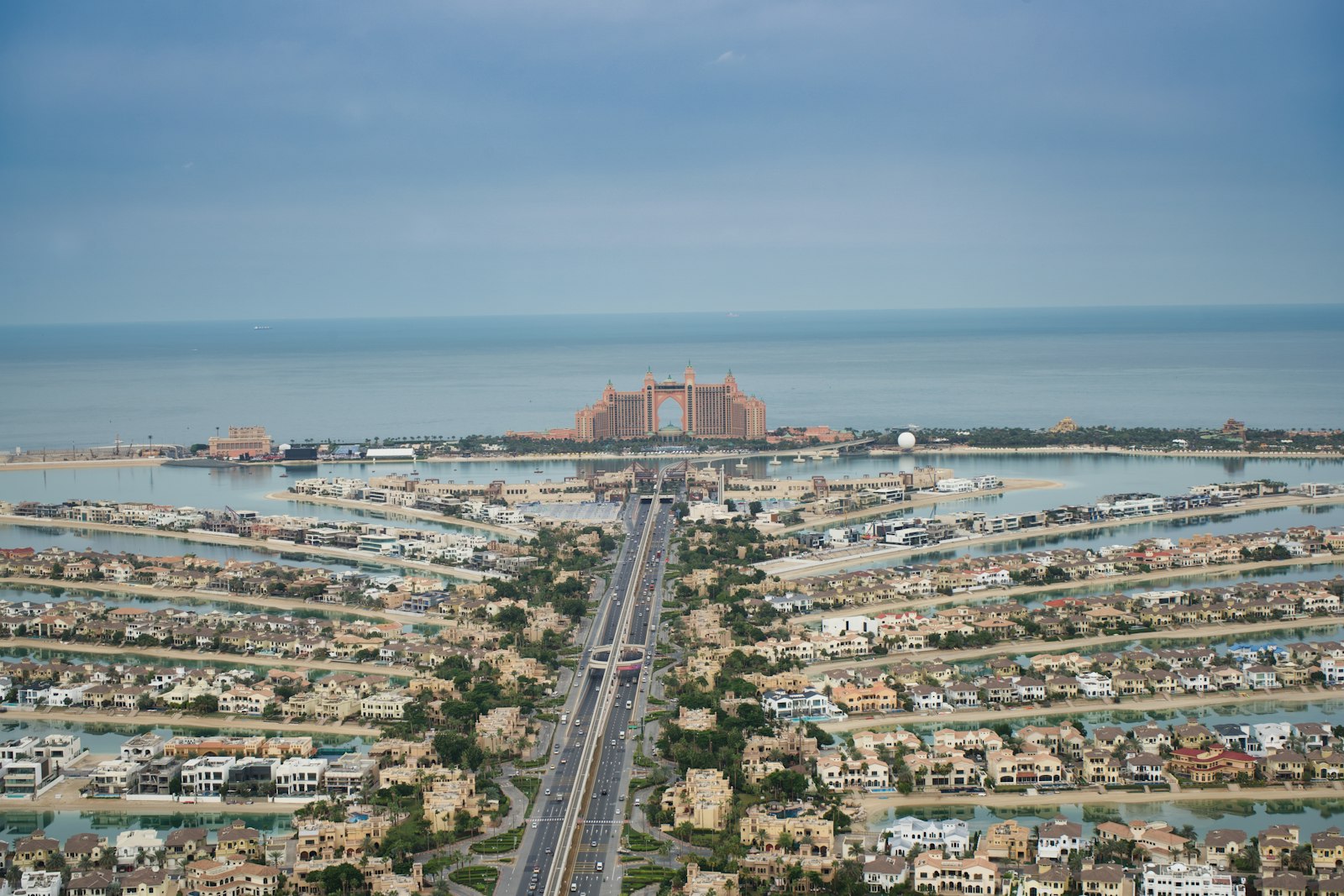
When I show guests the Palm from a helicopter or an observation deck, the first question is always the same: “How did they even build this?” The answer surprises people: no concrete base, just sand from the seabed and rock from the mountains. A 560-hectare island reaching five kilometres into the Gulf, and it all took only a few years.
Below is the engineering story of Palm Jumeirah, with figures from The View at The Palm museum, which belongs to the developer Nakheel, and from public sources. At the end: where to see the whole island and how to plan half a day on the Palm.
Why Dubai needed an island
Before the Palm, Dubai had about 72 km of coastline, and for a city betting on tourism, every kilometre of beach was worth its weight in gold. The View’s museum tells how the first proposal was a round island that would have added 7 km of coast. Sheikh Mohammed bin Rashid Al Maktoum wanted ten times more.
The shape of a date palm solved the problem: a trunk, 17 fronds and a crescent around them added about 70 km of shoreline, almost doubling the natural coast. The project was unveiled at Cityscape Dubai in 2001. Why Dubai bet on tourism and trade rather than oil in the first place is a story I tell in my history of Dubai.
Step one: a breakwater of 7 million tonnes of rock
An island in the open sea would have been washed away, so the protection came first: an 11 km crescent breakwater. Work began in summer 2001, the first 550 metres were ready by April 2002, and the whole breakwater was finished in October 2003, a few months ahead of schedule.
The numbers I love to share on tours:
- about 7 million tonnes of rock, which the museum says would be enough for two Pyramids of Giza;
- the rock came from 16 quarries in the northern emirates: gabbro and limestone;
- the breakwater is 200 metres wide at its base, in water up to 10.5 metres deep;
- the outer layer is limestone boulders of 6 tonnes each, roughly the size of a VW Beetle; the core is rocks of up to a tonne.
The breakwater has three layers with geotextile fabric between them: water passes through, but rock and sand don’t mix. Divers checked how every stone settled underwater.
Step two: 100 million cubic metres of sand
Then the island itself was reclaimed inside the sheltered water. It took almost 100 million cubic metres of limestone sand. The sand didn’t come from the desert: it was lifted from the seabed about 11 km (6 nautical miles) offshore.
You can sometimes see those ships even today. In September 2023 one of them, the same kind of Dutch dredger that once built the island, was anchored off the Palm all morning. And from a plane taking off from Dubai you can see a narrow strip near Deira: the start of Palm Deira, which was abandoned after the 2008 crisis and later reworked into the Dubai Islands project.
According to the museum, the world’s largest dredging fleet worked on the Palm. Cutter suction dredgers loosened the seabed and sucked up the sand, and trailing suction hopper dredgers brought it to the island at up to 8,000 tonnes an hour. The last stage was the most spectacular: the sand was sprayed from a nozzle in an arc that looked like a rainbow, which is why the method is called “rainbowing”. It laid sand quickly in shallow water. Reclamation was completed in August 2003.
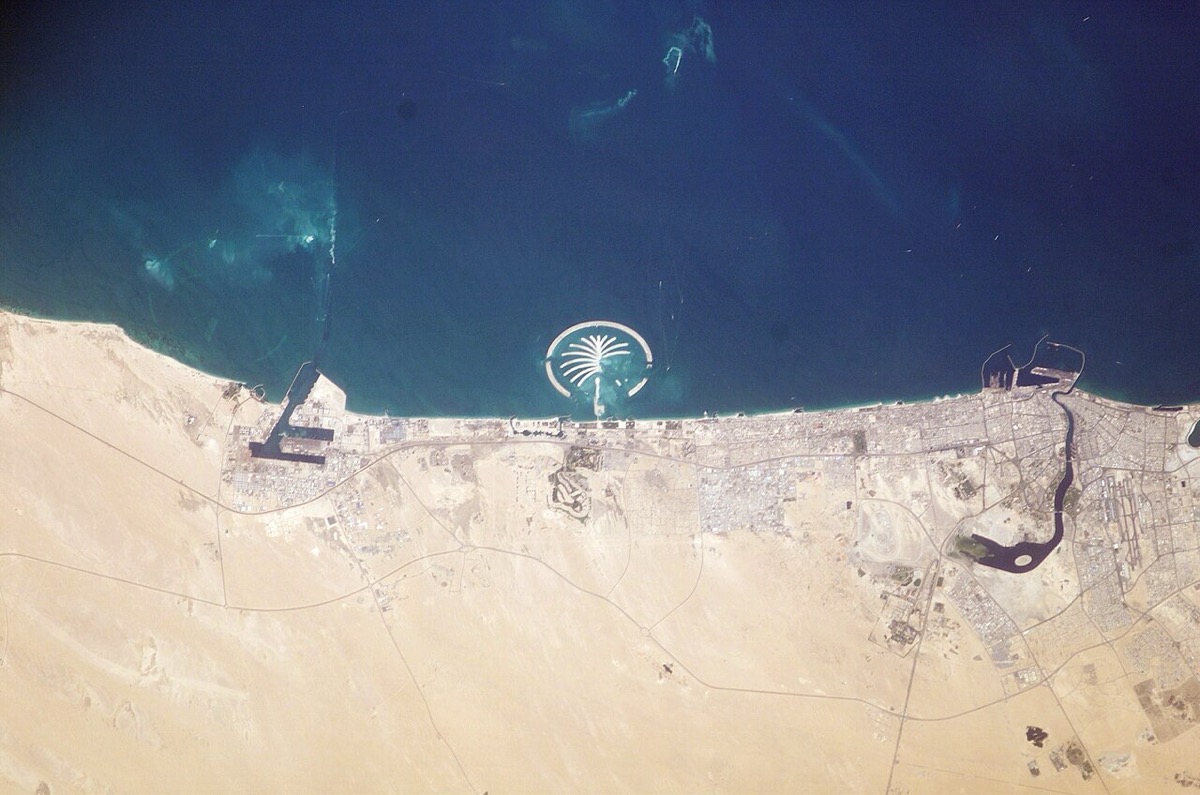
The Palm under construction, photographed by the ISS Expedition 6 crew (2002–2003): the crescent and fronds are in place, the houses not yet. Photo: NASA, public domain, Wikimedia Commons.
GPS and a view from space
How do you get a neat palm shape when you’re building in the open sea? The dredgers and construction machines laying the sand and rock carried GPS receivers linked to software written specially for the project. Progress was also checked against satellite images: The View’s museum mentions Ikonos, the first commercial high-resolution satellite. The finished island is 5.6 km long and 5.2 km wide.
Step three: compact the sand so it doesn’t shift
Reclaimed sand is loose. Put houses on it straight away and it will keep settling for a long time. Natural compaction, the museum estimates, would have taken decades.
So from March 2004 the engineers used vibro-compaction. Fifteen cranes drilled 200,000 holes 12 metres deep, and each one compacted a column of ground up to five metres across. Only then did building begin.
In 2009 The New York Times reported that satellite measurements showed the island sinking by a few millimetres a year; Nakheel disputed this, questioning the accuracy of the satellites themselves. Today people live on the island and the hotels are open.
Step four: get the water moving
A solid breakwater created a new problem: the water inside the crescent wasn’t refreshing well. After calculations on a three-dimensional model, two 150-metre gaps were cut in the breakwater, and the road along the crescent was carried over them on bridges.
From October 2004 an undersea tunnel 1.4 km long and 40 metres wide was built to connect the trunk with the crescent. To do it, a 3 km sheet-pile cofferdam was put around the site and more than 4.3 million cubic metres of seawater were pumped out. The tunnel took 200,000 tonnes of reinforced concrete.
How the island became a neighbourhood
According to the museum, more than 40,000 people and 51 contractors worked on the island. In 2002 Nakheel signed marine works contracts with Van Oord, the Dutch dredging specialist, and with Archirodon.
- 2006–2007: the first residents. By October 2007 about 500 families lived on the island.
- Autumn 2008: Atlantis The Palm opened at the tip of the crescent, with about 1,500 rooms.
- 2009: the 5.45 km monorail opened, the first in the Middle East.
- 2021: The View at The Palm opened on the 52nd floor of The Palm Tower.
Today the 17 fronds hold about 1,500 villas, roughly a hundred per frond, each with a pool and beach access. The trunk has apartment buildings and a mall, and most hotels stand on the 11 km crescent. According to Nakheel, about 25,000 people live on the Palm.
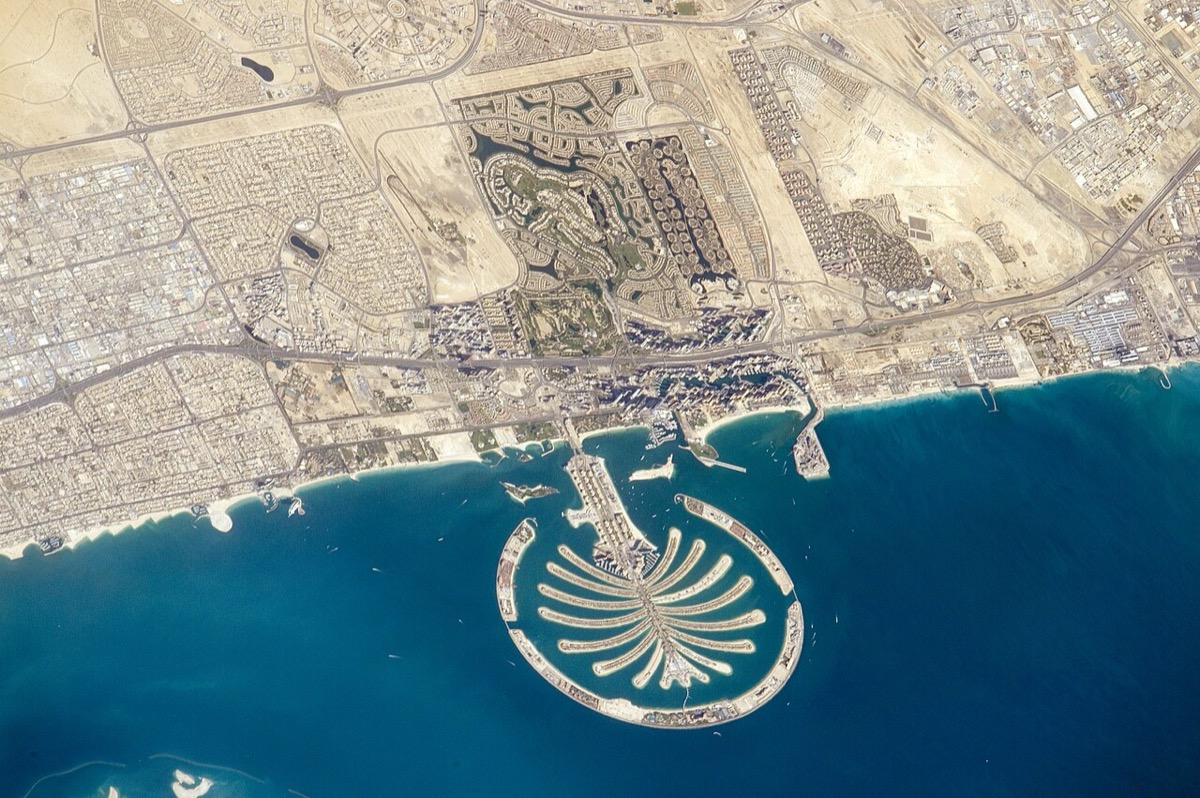
The same Palm from the ISS in 2016: the fronds are built up, and the towers of Dubai Marina have risen on the shore. Photo: NASA / Tim Kopra, public domain, Wikimedia Commons.
Where to see the whole Palm
The palm shape only shows from above or from a distance. I usually suggest one of four options:
- Helicopter. From the helipad at Atlantis you’re over the Palm right after take-off and see the whole design. Details are on my helicopter flight from Atlantis page and in my post on how to choose a helicopter route.
- Tethered balloon. Next to the Aquaventure waterpark a helium balloon rises to 225 metres, about 75 floors. It suits families with children: the balloon over the Palm.
- Observation deck. The View at The Palm on the 52nd floor looks straight down the trunk to Atlantis. How it compares with other decks is in my post on Dubai’s observation decks.
- From the water. From a yacht you see the breakwater, the gaps in it and Atlantis from the sea. Options are on my yacht charter page.
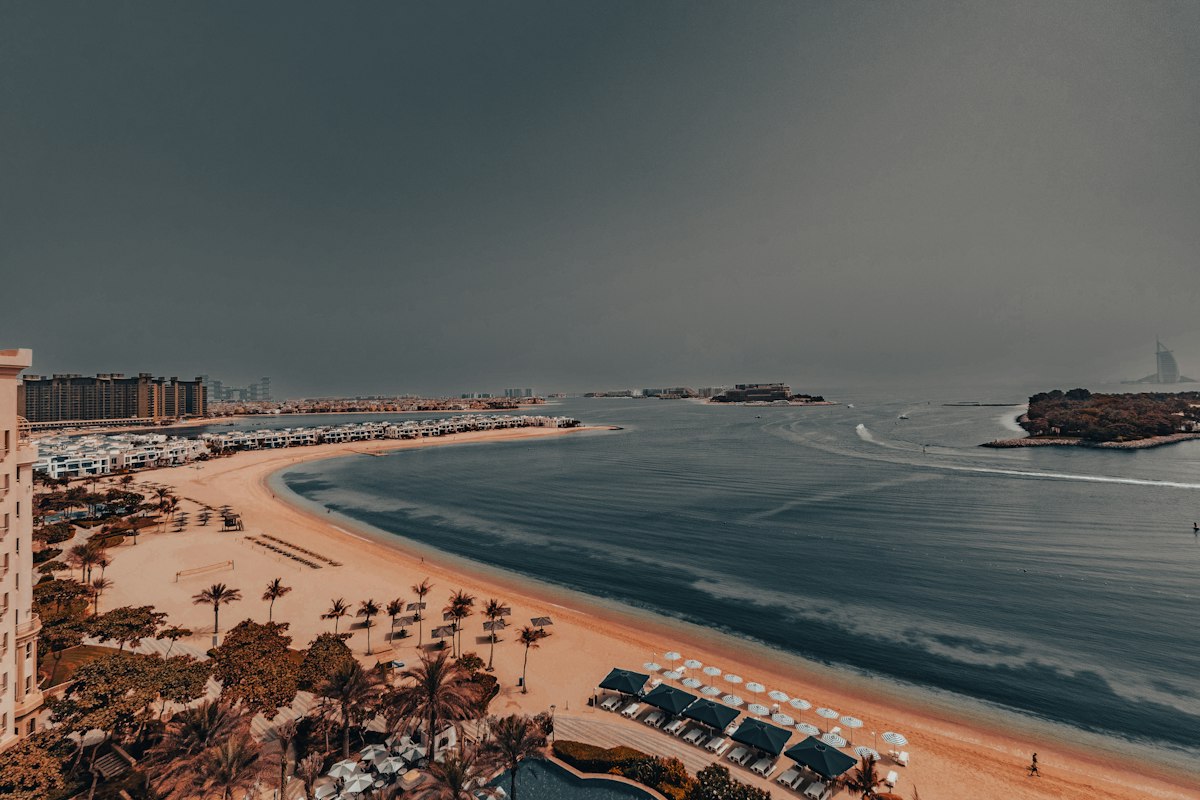
The Palm’s beaches are the 70 km of new coastline the island was built for. Photo: Nelemson Guevarra, Unsplash.
Half a day on the Palm: a realistic plan
| Time | What to do |
|---|---|
| 15:00 | Taxi to Atlantis along the trunk and through the tunnel under the lagoon: the drive shows how the island is laid out |
| 15:30–16:30 | Atlantis and the view of the breakwater from the crescent |
| 16:30–17:00 | The balloon at Aquaventure or a helicopter from the Atlantis helipad |
| 17:30–18:30 | The View at The Palm for sunset |
| 19:00 | Dinner and the dancing fountain at The Pointe |
From October to April this plan is easy. In summer, move everything outdoors closer to sunset, and don’t leave the helicopter or balloon for the last day of your trip: flights are rescheduled in strong wind.
How I can help
I show the Palm on my Dubai sightseeing tour and tell its engineering story on the way. I book helicopter flights, the balloon and observation deck tickets, and if you want to see the island from the sea, I’ll find you a yacht. Tell me how many of you there are and where you’re staying, and I’ll pick you up from your hotel and plan the day around you.
Checked on 11 October 2026. Sources: The View at The Palm museum (Nakheel), Nakheel, World Construction Network, The New York Times (2009) as summarised by Wikipedia.
Practical answers
Frequently asked questions
When was Palm Jumeirah built?
The project was announced in 2001, and work on the breakwater and land reclamation started the same year. Reclamation finished in August 2003, the first residents moved in during 2006–2007, and Atlantis opened in autumn 2008.
What is Palm Jumeirah made of?
Sand and rock. The island took almost 100 million cubic metres of limestone sand from the floor of the Gulf and about 7 million tonnes of rock from 16 quarries in the northern emirates.
Is Palm Jumeirah sinking?
No. The sand was deliberately compacted: from 2004, 200,000 holes were drilled and the ground was compacted by vibration. In 2009 the press reported subsidence based on satellite data, but the developer, Nakheel, disputed those findings.
How many people live on Palm Jumeirah?
About 25,000, according to the developer Nakheel. There are villas on the 17 fronds, apartment buildings on the trunk and hotels on the crescent.
Where is the best view of the whole Palm?
From a helicopter: the helipad at Atlantis is right on the island. You also get a good view from The View at The Palm on the 52nd floor of The Palm Tower, and from the tethered balloon at Aquaventure.
Can you get to Palm Jumeirah without a car?
Yes, by taxi. A 5.45 km monorail, the first in the Middle East, is built along the trunk from Palm Gateway station to Atlantis, but it is not running at the moment. Check its status at palmmonorail.com before you go.


