
Renting an apartment in Dubai isn’t hard, but it works in its own way: rent is paid in cheques for the year, the contract is registered in the government Ejari system, and without Ejari you can’t get electricity and water connected. If you know the steps in advance, the whole thing takes from a few days to a couple of weeks.
Below is the process step by step, the money you need up front and the rules that protect tenants: rent increases, the deposit and eviction. The figures are as of October 2026.
Step 1. Choose an area and a budget
First decide where you’ll work, whether you need a school and whether you’ll have a car. That decides the area. Average rents by area are in my guide to the best areas to live in Dubai. Tenants have more room to negotiate now than a couple of years ago: according to Colliers, apartment rents in Dubai fell 4% quarter on quarter in Q2 2026.
People usually search on Bayut, Property Finder or through an agent. Only work with an agent who holds a RERA broker card: you can check it on the DLD website and in the Dubai REST app.
One thing that trips up almost all my guests: apartments in Dubai are counted by bedrooms, not by rooms. A “two-bedroom” means two bedrooms plus a living room, which in many countries would be called a three-room flat. And back in 2022 I showed in my Instagram stories what renting looks like from the inside: on top of the annual rent, add the agent’s commission and a refundable deposit, and you’ll most often need to pay at least six months up front.
Step 2. Documents
For the contract you’ll usually need:
- your passport;
- a residence visa and Emirates ID: Ejari is harder to arrange without them. More on the visa in my post on the UAE residence visa;
- a chequebook from a local bank if you pay by cheque. How to open an account is in my post on opening a bank account in the UAE.
From the owner’s side: the title deed and their ID. Look at them: the contract must be signed by the owner or by someone with a power of attorney.
Step 3. The contract and cheques
Dubai uses a single standard tenancy contract form. A contract can run for less than a year or up to 10 years, but the norm is one year.
Rent is most often paid in post-dated cheques for the year: one, two or four. The fewer the cheques, the better the price, because the owner values the guarantee. More cheques, even monthly ones, are sometimes accepted, but usually at a higher price. Remember that in the UAE a cheque that bounces is a serious problem, so only write amounts and dates you’re certain you can cover.
What to check in the contract:
- who pays for maintenance and minor repairs;
- whether the cooling (chiller) charge is included: some buildings bill it separately, and in summer it adds up;
- whether pets are allowed;
- the early termination terms: whether there’s a penalty and how much, which should be written in the contract.
Step 4. Money up front
| What | Typical amount | Paid to |
|---|---|---|
| First rent cheque | as agreed | the owner |
| Deposit | most often 5% of annual rent unfurnished, 10% furnished | the owner, refundable |
| Agent’s commission | usually about 5% of annual rent plus VAT | the agency |
| Ejari | 100 AED + 10 + 10 AED in Dubai REST | DLD |
| DEWA deposit | 2,000 AED apartment, 4,000 AED villa | DEWA, refundable |
| DEWA connection | 100 or 300 AED depending on the meter, plus fees | DEWA |
The deposit and commission are market practice, not a fixed tariff: everything is negotiable.
One more cost people often forget: the Dubai Municipality housing fee, 5% of the annual rent on the Ejari contract. It’s added to your monthly DEWA bill in equal instalments.

When you move in, photograph every room and every defect: you’ll need those photos when you claim your deposit back. Photo: Shixart1985, CC BY 2.0, Wikimedia Commons
Step 5. Ejari
Ejari is the registration of your tenancy contract with the Dubai Land Department. It’s mandatory. You can register it:
- in the Dubai REST app: 100 AED plus fees of 10 and 10 AED;
- at Real Estate Services Trustee centres: 120 AED plus the service partner’s fee.
Often the agent handles Ejari. One important detail from the DLD FAQ: one person can hold no more than three active residential Ejari contracts.
Step 6. DEWA: electricity and water
Once Ejari is registered, DEWA sends you the account number and deposit amount by email and SMS. Pay it, and the connection is usually done quickly. The DEWA deposit is refunded when you close the account and pay the final bill on moving out.
Rent increases: the RERA index
Since 2 January 2025 the Dubai Land Department has used a smart rental index. Buildings are classified by condition, quality of finishing and maintenance, location and services. The index is a guide for new contracts, and on renewal it becomes binding if the parties disagree.
How much rent can rise on renewal:
| Your rent below the index average | Maximum increase |
|---|---|
| less than 10% | 0% |
| 11–20% | 5% |
| 21–30% | 10% |
| 31–40% | 15% |
| more than 40% | 20% |
You can check your apartment with the rental index calculator on the DLD website or in Dubai REST. Either party that wants to change the terms must notify the other at least 90 days before the contract ends (unless the contract says otherwise). Without notice, the contract usually renews on the same terms.
Eviction: when and how
Under Dubai Law No. 33 of 2008, a tenant can be evicted early for non-payment, for example: if they haven’t paid within 30 days of being notified. Notices are sent through a notary public or by registered mail.
After the contract ends, the owner can only demand eviction for specific reasons: demolition or reconstruction with permits, repairs that can’t be done with tenants in place, sale, or the owner or a first-degree relative moving in if they have no other suitable home. In these cases the owner must give at least 12 months’ notice through a notary public or by registered mail. If the owner evicts in order to move in, they can’t rent the home to another tenant for at least two years; otherwise the tenant can claim compensation.
Rental disputes are heard by the Rental Dispute Center.
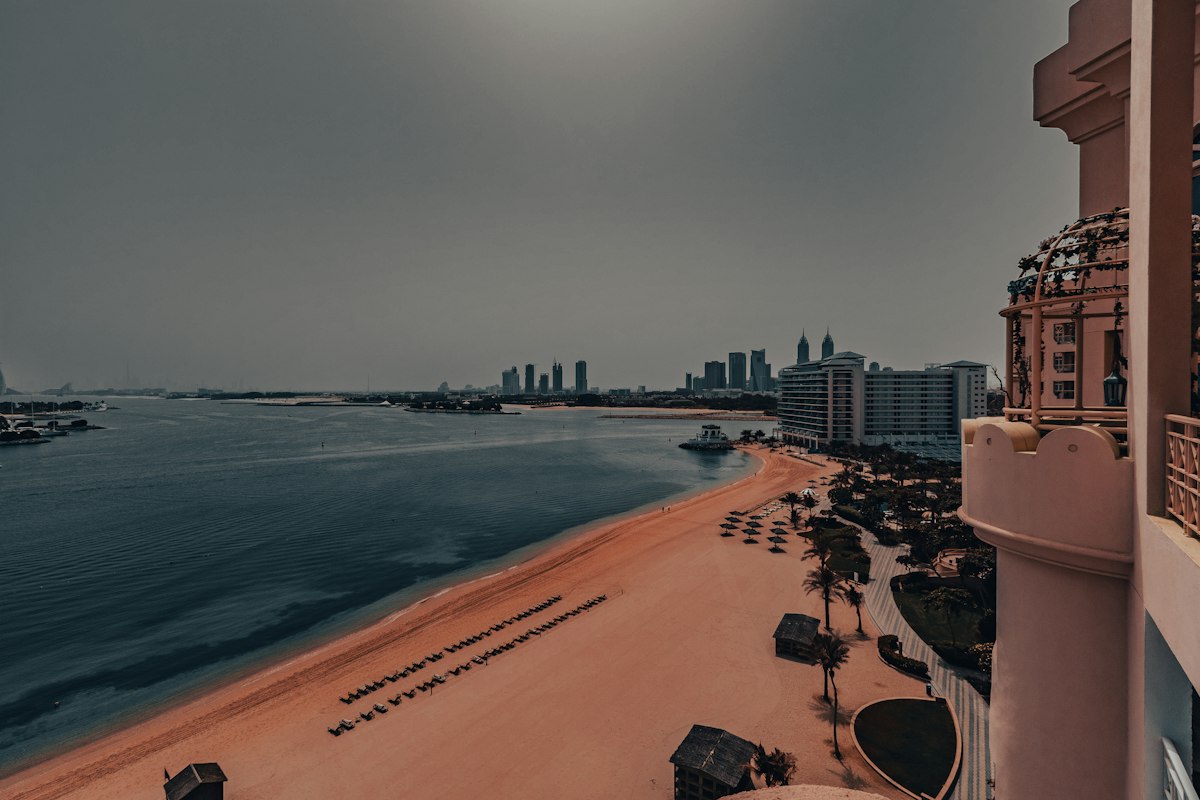
A view from the window is a lovely bonus, but check the drive to work at rush hour first. Photo: Milkwalkie, CC BY-SA 4.0, Wikimedia Commons
How I can help
I’m not an agent and I don’t search for apartments. But before you sign a one-year contract, the area is worth seeing. In a day I can drive you through the areas on your list: where the metro is, what the road looks like at rush hour, where the schools and shops are. I’ll pick you up from your hotel and, if you need it, introduce you to agents I trust.
If you’re just getting to know Dubai, start with my Arabian Dream city tour. The comparison of renting and buying is in rent or buy in Dubai.
This isn’t legal or investment advice: rules and prices change, so check them before any transaction.
Checked on 11 October 2026. Sources: Dubai Land Department (FAQ, rental index), Dubai Media Office, Dubai Law No. 33 of 2008, DEWA via Bayut, Colliers via Khaleej Times.
Practical answers
Frequently asked questions
What is Ejari and who registers it?
Ejari is the mandatory registration of a tenancy contract with the Dubai Land Department. Without it you can't connect DEWA. Usually the tenant or the agent registers and pays for it: in the Dubai REST app it's 100 AED plus two 10 AED fees.
How much money do I need to rent an apartment in Dubai?
Besides the first rent cheque, you usually pay a deposit (most often 5% of annual rent unfurnished, 10% furnished), the agent's commission (usually about 5% plus VAT), Ejari and a 2,000 AED DEWA deposit for an apartment.
Can I pay rent monthly in Dubai?
Rent is usually paid in cheques for the year ahead: one, two or four. Landlords sometimes accept more cheques, even monthly ones, but usually at a higher price. It's an agreement with the owner, not a rule.
How much can my rent go up on renewal?
From 0 to 20%, depending on how far your rent is below the DLD rental index average. If the gap is under 10%, no increase is allowed. Any change of terms requires at least 90 days' notice before the contract ends.
Can a landlord evict me to sell the apartment?
Yes, but only after the contract ends and with at least 12 months' notice through a notary public or by registered mail. The same applies if the owner or a first-degree relative wants to move in.
Will I get my deposit back when I move out?
According to the DLD FAQ, the owner must return the deposit or what's left of it after the contract ends, provided the property is returned in its original condition. Disputed deductions are decided by the Rental Dispute Center.
