
The cost of living in Dubai is a question I hear on tours almost as often as the one about salaries. In February 2024 I asked my followers in my stories how much you need to earn for a comfortable family life with children, and the answers differed several times over. That is fair: the same family can spend AED 20,000 or AED 80,000 a month, and two or three choices decide which.
I have lived in the UAE for more than 15 years. Below is a budget by category, with every figure taken from an official or well-known source and checked on 24 October 2026, and five examples, from a studio for one person to a villa on the Palm. These are not my own accounts but a calculation from public data. Amounts are in dirhams (AED) per month unless stated otherwise. The dirham is pegged to the dollar: USD 1 is AED 3.6725 (The National).
In short: what living in Dubai costs
| Who | Where | Monthly spending | Income needed |
|---|---|---|---|
| One person, minimum | studio in JVC | AED 8,000 to 9,000 | from AED 12,000 to 13,000 |
| One person, own flat | one-bedroom in JVC | AED 10,000 to 11,000 | from AED 16,000 to 18,000 |
| One person, the city life | one-bedroom in Downtown, own car | AED 16,500 to 19,000 | from AED 27,000 to 30,000 |
| Family with a child | one or two bedrooms in JVC, inexpensive school | AED 22,000 to 25,500 | from AED 30,000 to 36,000 |
| Family living large | villa, two top schools, live-in help | AED 70,000 to 85,000 | from AED 95,000 to 115,000 |
How to read the table: rent is Bayut’s average asking rent for October 2026 divided by 12; everything else is Numbeo’s estimate. Income needed assumes spending stays within about 75% of income and rent within about 40%; the rest goes on savings, flights home and the unexpected. All amounts are rounded: they show the order of magnitude, not an estimate to the dirham. Each example is worked out below.
What the budget is made of
Rent: the biggest line
Rent takes a third to a half of a Dubai budget. Average annual rents from Bayut, updated 13 to 19 October 2026:
| Area | Studio | One-bedroom | Two-bedroom |
|---|---|---|---|
| Jumeirah Village Circle (JVC) | AED 50,000 | AED 74,000 | AED 108,000 |
| Dubai Marina | AED 65,000 | AED 93,000 | AED 144,000 |
| Business Bay | AED 67,000 | AED 94,000 | AED 139,000 |
| Downtown | AED 75,000 | AED 121,000 | AED 205,000 |
Villas are another world: a three-bedroom villa in Arabian Ranches averages AED 265,000 a year, a four-bedroom AED 414,000, and the average villa on Palm Jumeirah AED 1,707,000. These are asking prices; real contracts are usually a little lower. Which area suits which life is covered in Best Areas to Live in Dubai.
On top comes the housing fee: 5% of the annual rent, split into 12 parts and added to your electricity and water bill (as Bayut describes it). On a rent of AED 74,000 that is about AED 300 a month. To move in you also need a deposit, the agent’s fee and the cheques, step by step in Renting an Apartment in Dubai.
Good news for anyone moving now: according to Savills’ third-quarter 2026 report (as reported by Khaleej Times on 13 October), apartment rents fell year on year by 10 to 13% in Dubai Marina, Business Bay and JVC. At the same time, Dubai’s price index shows housing and utility costs up about 6% over the year. They measure different things: Savills compares rents by area, while the index tracks what residents across the emirate spend on housing overall. The takeaway is simple: in popular areas it is worth negotiating right now.
Electricity, water, internet and phone
Your DEWA bill depends on the season: in summer the air conditioning runs almost around the clock. DEWA tariffs for October 2026:
- electricity: 23 fils per kWh up to 2,000 kWh a month, then 28, 32 and 38 fils, plus a fuel surcharge of 6 fils per kWh;
- water: AED 7.70 per cubic metre up to 27 m³, then AED 8.80 and 10.12, plus a surcharge of AED 1.10 per cubic metre;
- 5% VAT on everything.
For a sense of scale: a month in which a flat uses 1,000 kWh costs about AED 300 for electricity alone, before VAT. Numbeo users put electricity, water and cooling for an 85 m² flat at about AED 900 a month (usually AED 550 to 1,500). Internet is about AED 300 to 350 and a mobile plan about AED 200 a month.
Food and everyday costs
As of 24 October 2026, Numbeo estimates one person’s costs excluding rent at about AED 4,100 a month and a family of four’s at about AED 14,500. That covers groceries, cafes, transport, phone, clothes and leisure. A few prices from the same source: a litre of milk AED 6 to 7, a dozen eggs AED 12 to 13, lunch in an inexpensive cafe AED 45 to 50, dinner for two in a mid-range restaurant about AED 300, a cappuccino about AED 20.
Allow for rising prices: according to the Dubai Data and Statistics Establishment (DDSE), food and drinks rose about 8% in the year to September 2026, and overall inflation in Dubai was about 5%. Where to eat well without overpaying: Where to Eat in Dubai.
Transport: metro or car
This is the second big choice after the area. A metro trip on a Silver nol card costs AED 3 within one zone, AED 5 across two zones and AED 7.50 beyond that (RTA). Commuting across two zones five days a week comes to AED 200 to 250 a month.
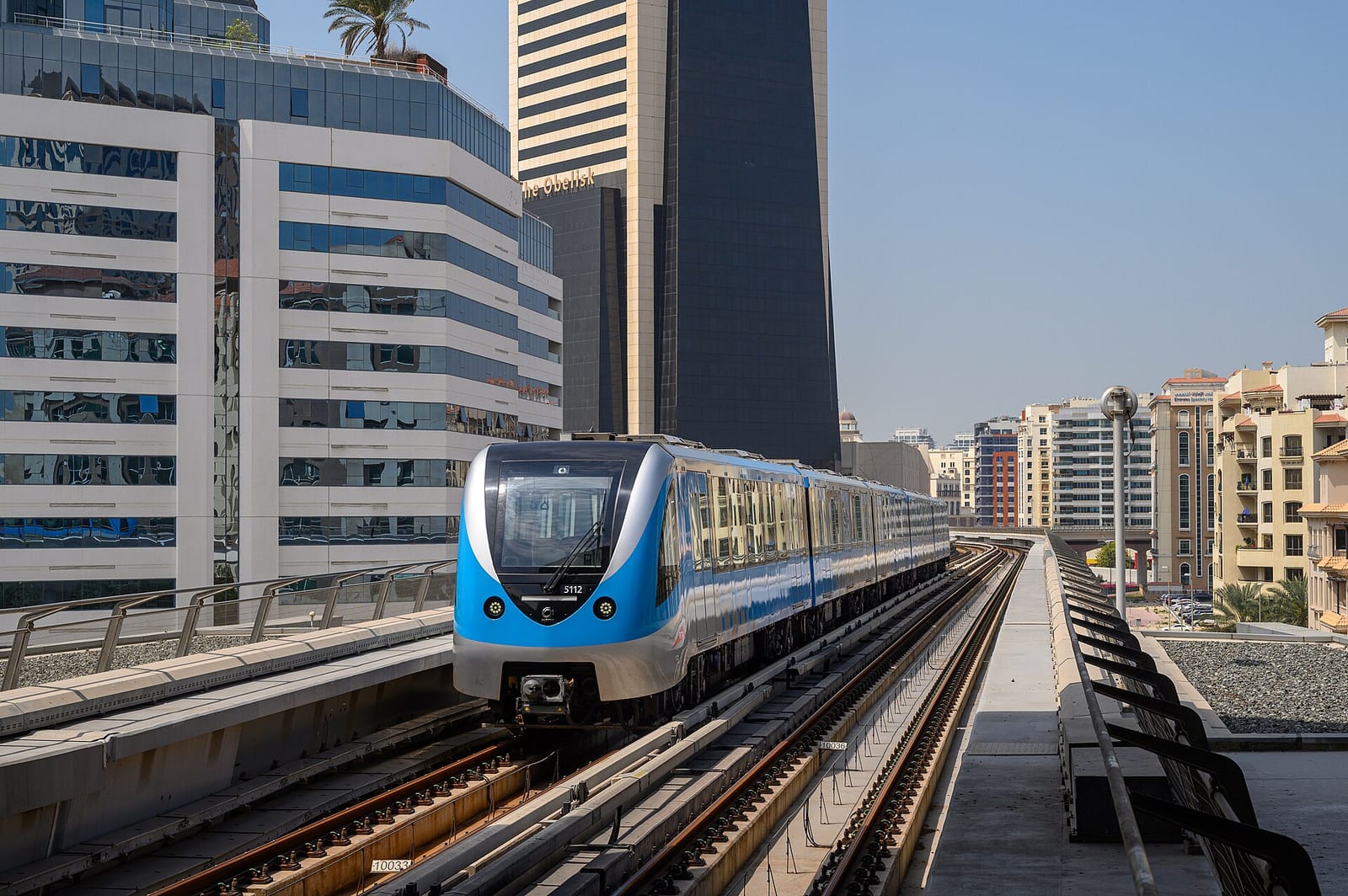
The Green Line near Dubai Healthcare City. Living near a metro station saves thousands of dirhams a month on a car. Photo: Rob Dammers, CC BY 2.0, Wikimedia Commons.
A car is a different order of magnitude. dubizzle suggests budgeting AED 2,000 to 4,000 a month for fuel, insurance, registration and servicing, excluding loan payments. Petrol rose sharply in October 2026: a litre costs AED 4.20 to 4.40 depending on the grade, about 16% more than a month earlier according to Gulf News. Fuel is the main reason transport rose almost 15% over the year in Dubai’s price index. More on the metro, taxis and nol in Dubai Metro, Taxis and the nol Card.
School and nursery
For a family this is the second line after rent. The good news of 2026: on 22 May KHDA confirmed that Dubai’s private schools will not raise fees for the 2026/27 academic year. Benchmarks:
- a British school rated Very good, for example The Winchester School: AED 14,950 to 33,352 a year (Gulf News, August 2026);
- the 23 schools rated Outstanding: AED 29,488 to 111,799 a year, with the British ones from AED 43,084 (Khaleej Times, July 2026);
- nursery: usually AED 2,000 to 5,000 a month, about AED 3,400 on average as estimated by Numbeo users.
Uniforms, books, the bus and the registration fee come on top. How to choose a school: Schools in Dubai.
Health insurance
Employers must insure their employees, and the family’s sponsor, usually the employee, pays for the spouse’s and children’s cover (u.ae). The basic package for private-sector employees and domestic workers costs AED 320 a year, but families often choose broader cover, and the price depends heavily on age and the clinic network. How insurance works: Healthcare in the UAE.
Tax, holidays and savings
There is no personal income tax in the UAE; the government portal u.ae says so plainly. There is 5% VAT on purchases and the housing fee. That makes saving easier than in many countries, but only if rent and school fees do not swallow your income.
Budget a separate line for holidays and flights home: they barely appear in Numbeo’s estimate, and fares jump around. In September 2026 airfares fell almost a quarter month on month but were still 13 to 14% higher than a year earlier (DDSE). Another cushion is end-of-service gratuity, calculated on basic salary: details in Salaries in the UAE.
Five examples: what the money covers
Every example is built the same way: rent from Bayut’s table divided by 12, plus the 5% housing fee, plus Numbeo’s estimate for everything else. Amounts are rounded: treat them as a guide, not an estimate, and put in your own habits. Income needed assumes spending stays within about 75% of income and rent within about 40%.
1. One person: a studio, income from AED 12,000
- a studio in JVC, AED 4,000 to 4,500 a month with the housing fee;
- everything else per Numbeo, about AED 4,000 to 4,200.
AED 8,000 to 9,000 a month in total. To have something left for flights, the unexpected and some savings, you need an income from AED 12,000 to 13,000. On AED 10,000 your own studio is a stretch: a legal room, a cheaper area or employer housing is more realistic. Life on this budget means no car, the metro and taxis, and modest restaurants.
2. One person: a one-bedroom, income from AED 16,000
- a one-bedroom in JVC, AED 6,000 to 6,500 with the housing fee;
- everything else, about AED 4,000 to 4,200.
AED 10,000 to 11,000 in total. Rent is the biggest part of this budget, so a comfortable income starts at about AED 16,000 to 18,000. If you want to live by the water and the metro, a one-bedroom in the Marina is AED 7,500 to 8,500 with the fee, and the income needed rises to AED 20,000 or more. That is a normal life with a holiday a year, as long as you do not buy a car on credit.
3. One person: the centre and your own car, income from AED 27,000
- a one-bedroom in Downtown, AED 10,000 to 11,000 with the fee;
- everything else, about AED 4,000 to 4,200;
- a car instead of the metro, AED 2,000 to 4,000.
AED 16,500 to 19,000 in total, and the income for this life starts at AED 27,000 to 30,000. This is the life from the films: Burj Khalifa from your window, your own car, restaurants at weekends, and still money to save.
4. A family with one child: the income you need
Formally you can sponsor your family on a salary of AED 4,000 a month, or AED 3,000 with employer housing (u.ae). Living on that with a child in Dubai is practically impossible. A realistic calculation for two adults and a school-age child:
| Item | Tight | Normal |
|---|---|---|
| Rent in JVC with the fee | one-bedroom, AED 6,000 to 6,500 | two-bedroom, AED 9,000 to 10,000 |
| Everything else (Numbeo, family of four) | about AED 14,500 | about AED 14,500 |
| Very good school, junior years | AED 1,200 to 1,300 | AED 1,200 to 1,300 |
| Total | AED 22,000 to 22,500 | AED 25,000 to 25,500 |
| Income with a margin | from AED 30,000 | from AED 34,000 to 36,000 |
Numbeo’s estimate is for four people, so for three it has some headroom, but add family insurance, holidays and a car yourself. If the child is still at nursery, put in AED 3,000 to 3,500 instead of the school, and the normal option rises to AED 27,000 to 28,000 a month. Hence the guide: a family with a child needs an income from AED 30,000 to 36,000 a month so as not to live from payday to payday. More in Living in Dubai with Kids.
5. A family living large
There is no ceiling here, so two levels.
A villa in a community. A four-bedroom villa in Arabian Ranches is AED 35,000 to 37,000 a month with the housing fee. Two British schools rated Outstanding cost AED 7,000 to 19,000 a month for two children. A live-in housekeeper: the service company ServiceMarket estimates the full cost at AED 75,000 to 85,000 a year, AED 6,000 to 7,000 a month. Two cars, AED 4,000 to 8,000. Everyday costs from AED 14,500, and usually more at this level. That comes to AED 70,000 to 85,000 a month, and the income with a margin starts at AED 95,000 to 115,000.
A villa on the Palm. The average villa rent on Palm Jumeirah is AED 1,707,000 a year, AED 140,000 to 150,000 a month with the fee. With the same schools, help and cars, the budget approaches AED 200,000 a month. If rent is to stay within 40% of income, this life starts at an income of about AED 375,000 a month, and that is before a yacht, clubs and Michelin-starred restaurants. More in What a Luxury Life in Dubai Costs.
Common mistakes in the sums
- Thinking of rent per month. Leases in Dubai are annual and paid in cheques, sometimes one or two. You need the money for the first year, the deposit and the agent’s fee in advance.
- Forgetting the summer. In July and August the air conditioning runs almost non-stop and the DEWA bill is well above the winter one. Budget on a summer month.
- Taking the formal threshold for the real one. AED 4,000 for a family visa is a paperwork threshold, not a budget.
- Not planning school costs years ahead. Each year group usually costs more, even when fees are frozen.
- Comparing salaries only. Housing, school, flights and insurance from the employer change the picture more than the difference in base pay.
How I can help
I don’t advise on relocation, jobs or finances. But if you have come to see how people live here, on a Dubai city tour we will drive from the business centre to the residential areas, and you will see for yourself how the Marina differs from Downtown. Visas and family sponsorship are covered in UAE Residence Visa.
This is not legal or investment advice: prices, tariffs and rules change, so check them before you decide.
Checked on 24 October 2026. Sources: Bayut (area guides, October 2026), Numbeo (24 October 2026), DEWA, RTA, u.ae, Dubai Media Office (KHDA), Gulf News, Khaleej Times (Savills, schools, petrol), The National (DDSE data, dirham peg), dubizzle, ServiceMarket.
Practical answers
Frequently asked questions
How much does it cost to live in Dubai per month?
One person in a studio in an affordable area spends AED 8,000 to 9,000 a month: AED 4,000 to 4,500 for rent with the housing fee and about AED 4,100 for everything else (Numbeo, October 2026). To have a margin, that takes an income from AED 12,000. A family with one child spends AED 22,000 to 25,500 with an inexpensive school. Rent is the main variable.
How much money do you need to live in Dubai as a single person?
Your own studio in an affordable area costs AED 8,000 to 9,000 a month. To live without scraping by and still save, you need an income from AED 12,000 to 13,000; for a one-bedroom, from AED 16,000 to 18,000.
What income does a family with a child need in Dubai?
The formal threshold to sponsor your family is AED 4,000 a month (u.ae), but you cannot live on it. Realistic spending for two adults and a child is AED 22,000 to 25,500 a month with an inexpensive school, and the income for that life starts at AED 30,000 to 36,000.
What is the most expensive part of living in Dubai?
Rent and private school. A one-bedroom in Dubai Marina averaged AED 93,000 a year in October 2026 (Bayut), and a year at a school rated Outstanding costs AED 29,488 to 111,799 (Khaleej Times, from KHDA data).
How much does it cost to live in Dubai in US dollars?
The dirham is pegged to the dollar at AED 3.6725. A single person spending AED 8,000 to 9,000 spends about USD 2,200 to 2,450 a month, and an income from AED 12,000 is from about USD 3,300. A family with a child spends AED 22,000 to 25,500, about USD 6,000 to 6,900.
Is there income tax in Dubai?
No, the UAE does not tax individuals’ income. There is 5% VAT on goods and services, and in Dubai a housing fee of 5% of annual rent, added to your electricity and water bill.