When people ask me whether now is a good time to buy in Dubai, I start with a story. In 24 years this market has had two real booms, one crash that halved prices, one long slump and, right now, another turn. If you know these cycles, you trust glossy brochures less and read the news more calmly.
This isn’t a forecast or advice on what to buy. It’s a chronicle with numbers: what happened, how far prices moved and what lessons stand out. The figures come from the Colliers, Cluttons and ValuStrat indices, Dubai Land Department (DLD) data and the business press, as of October 2026.
2002–2008: the gold rush
Before 2002 a foreigner couldn’t own land in Dubai. In May 2002 the then Crown Prince, Sheikh Mohammed bin Rashid, allowed foreigners to own property, and, as Oxford Business Group put it, that set off a buying frenzy. On 28 May 2002 Emaar announced freehold sales of homes in Emirates Hills, Dubai Marina and Arabian Ranches, to Emiratis and expats alike.
At the same time, Palm Jumeirah was being reclaimed from the sea. A 2003 photo from the International Space Station shows the outline of the island appearing in the Gulf, with desert still stretching inland from the coast.
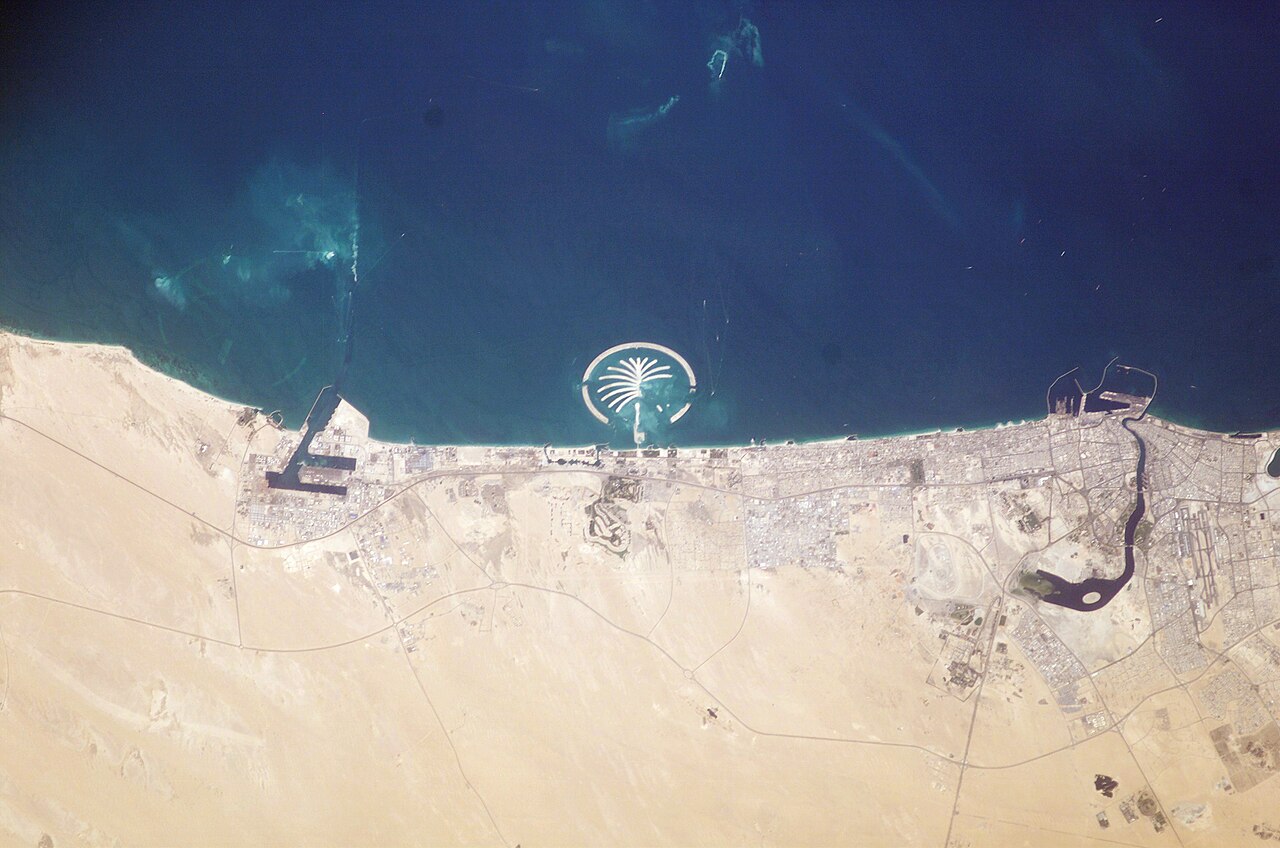
March 2003: Palm Jumeirah is still being reclaimed, and the future districts around it are mostly empty sand. Photo: NASA, public domain, Wikimedia Commons.
The law caught up with the market. On 13 March 2006 Dubai Law No. 7 on property registration came out: foreigners can own freehold property with no time limit or lease it for up to 99 years, but only in areas designated by the Ruler. On 6 May 2007 came Law No. 8 on escrow accounts: a developer can sell off-plan only after opening an escrow account for the project, and money from it goes only to building that project.
Meanwhile the market was accelerating. According to Oxford Business Group, a house that sold for about 150,000 dollars in 2003 went for 300,000 or more in 2005, and rents rose by an average of 40% in 2005 alone. By the Colliers index, prices rose 43% in Q1 2008 alone.
The sport of the era was flipping. As Gulf News recalls, off-plan apartments changed hands three to five times in a few hours, sometimes to the person standing behind the buyer in the same queue. Each new buyer got not an apartment but an obligation to pay the balance.
2008–2010: the crash and Abu Dhabi’s help
By autumn the growth was running out of steam: by Colliers, prices rose 16% in Q2 2008 and only 5% in Q3. Then the global financial crisis reached Dubai and the market collapsed. Prices fell 42% in Q1 2009 alone, and by Q2 they were 50% below the Q3 2008 peak, back to mid-2007 levels, The National reported from the Colliers index. Cluttons later put the whole fall at 49.7%.
The loudest projects stopped. In January 2009 Nakheel suspended work “for 12 months” on a tower about a kilometre high, Property Week reported. It was never built.
At the end of November 2009 Dubai World, Nakheel’s parent, couldn’t service 26 billion dollars of debt, and global markets shook. On 14 December Abu Dhabi gave Dubai 10 billion dollars, 4.1 billion of which went to repay Nakheel’s Islamic bonds, Al Jazeera reported. On 4 January 2010 the world’s tallest tower opened under a new name: Burj Khalifa instead of Burj Dubai, after the ruler of Abu Dhabi, Sheikh Khalifa bin Zayed, NBC News reported.
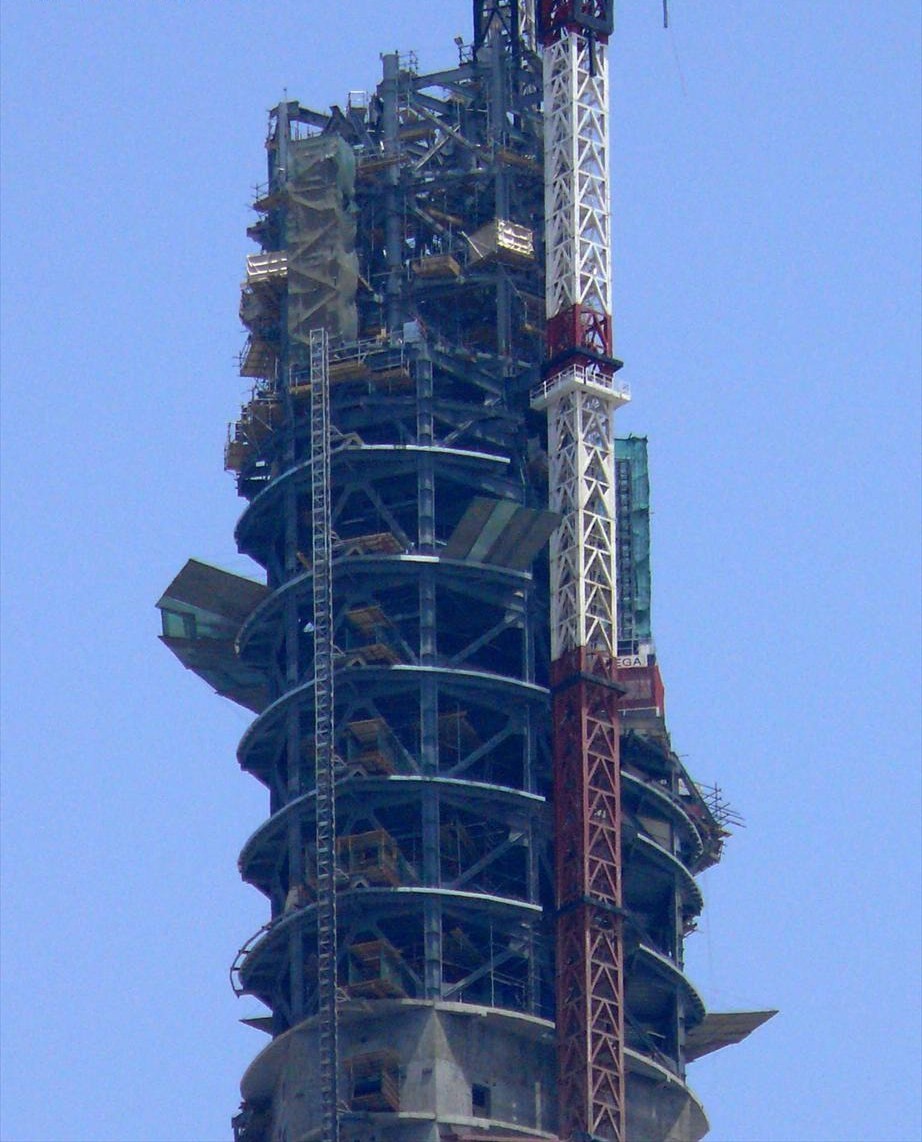
May 2008: the future Burj Khalifa is still called Burj Dubai and is still rising. Photo: Imre Solt, CC BY-SA 3.0, Wikimedia Commons.
2011–2014: recovery and the first brakes
The market recovered faster than many expected. By Cluttons, in summer 2013 prices were 36.9% above the Q2 2009 bottom, though still 31.1% below the 2008 peak. On 27 November 2013 Dubai won the right to host Expo 2020 with 116 votes out of 163; its main rival was Yekaterinburg, Khaleej Times reported.
This time the authorities started cooling the market early:
- The DLD fee doubled: from 6 October 2013 it went from 2% to 4% of the price, and the head of DLD told journalists plainly that the aim was to curb flipping.
- Mortgages were capped: in Q4 2013 the UAE Central Bank allowed an expat buying a first home worth up to AED 5 million to borrow no more than 75% of the price, 65% above that, and 60% on a second home, Gulf News reported.
In 2014 the IMF noted that by some measures Dubai house prices were already back at their 2008 peak and warned about speculative demand.
2014–2020: the long slump
What followed wasn’t a cliff but a slow slide. The National linked it to three years of falling oil prices and oversupply. By ValuStrat, Q2 2019 prices were 29.3% below the mid-2014 peak. Then came the pandemic, and in January 2021 Bloomberg, citing JLL, reported a fall of more than 30% from the peak.
The main difference from 2009 was duration. Someone who bought in 2014 waited six years to see prices rise.
2021–2025: the second boom
Because of the pandemic, Expo 2020 took place in 2021–2022, and that’s where the new cycle began. By ValuStrat, in December 2025 villas were worth 206% more than after the pandemic and 86% above the 2014 peak, while apartments passed their 2014 level for the first time, Gulf News reported. In 2025 Dubai recorded more than 270,000 transactions worth AED 917 billion, a record, according to the government Media Office.
I watched this boom from the inside. In September 2022 I told my Instagram followers that rental demand was frantic and rents were up 30–70% on 2019, at least in the buildings I know. And in October that year Nakheel announced the relaunch of the second Palm, Palm Jebel Ali: the coast was running out of room.
One important detail: the growth was uneven. Villas went far past their old peak, while apartments only caught up with theirs.
2026: another turn
In 2026 the market slowed down. By ValuStrat, the September index was 4.5% lower than a year earlier: villas −3.4%, apartments −6.4%. By Colliers, apartment and villa prices fell 3% quarter on quarter in Q2, and about 56,600 more homes are expected to be handed over by the end of the year. Back in 2025, Fitch expected a correction of about 15% between July 2025 and the end of 2026.
The cycles in one table
| Period | What happened | Prices (source) | Lesson for buyers |
|---|---|---|---|
| 2002–2008 | Freehold for foreigners, off-plan boom, flipping | +43% in Q1 2008 alone (Colliers) | Growth built on resales ends abruptly |
| 2008–2010 | Global crisis, Dubai World debt, Abu Dhabi’s help | −50% from the peak by Q2 2009 (Colliers) | Off-plan is dangerous without money for the balance |
| 2011–2014 | Recovery, Expo 2020, 4% fee and mortgage caps | +36.9% from the bottom by summer 2013 (Cluttons) | The authorities know how to cool the market |
| 2014–2020 | Cheap oil, oversupply, pandemic | −29.3% by 2019 (ValuStrat), more than −30% by 2021 (JLL) | A downturn can last years |
| 2021–2025 | Expo, inflow of residents and capital, record deals | Villas +86% over the 2014 peak (ValuStrat, 2025) | Segments move differently |
| 2026 | Slower demand, large handover volumes | −4.5% year on year to September (ValuStrat) | The cycle hasn’t been cancelled |
What makes Dubai attractive, and what to fear
What objectively works in Dubai’s favour:
- Yield: average gross residential yield in June 2026 was 6.6%, and 6.9% for apartments, by Engel & Völkers; net yield is lower, details in my Dubai property investment guide.
- Taxes: there’s no annual property tax, inheritance tax or wealth tax for individuals in the UAE, according to PwC. On purchase you pay the 4% DLD fee, and the 5% municipality housing fee on rent is usually paid by the tenant.
- The dirham: pegged to the US dollar since February 2002 at 3.6725, according to u.ae.
- The visa: an owner of property worth AED 2 million or more can apply for 10-year residency if they meet ICP’s conditions; more in my golden visa through property post.
- Off-plan buyer protection: escrow accounts under the 2007 law and registration of contracts with DLD, covered in my off-plan guide.
What’s worth fearing:
- Cycles: in 24 years prices have twice fallen by tens of percent.
- Supply: when several large projects hand over in one area, prices and rents there sag. Look at what’s being built nearby; more in Dubai areas for investment.
- Off-plan liquidity: in September 2026 off-plan made up 70% of residential deals, by ValuStrat, and, by practitioners’ estimates quoted in Fortune, apartments resold before handover went for 10–15% below the original price.
- Geopolitics: 2026 showed that the region moves demand faster than any statistic.
- Leverage: in 2009 those who had bought without money for the balance came off worst.
Why Dubai grows so fast in the first place is in why Dubai succeeded.
How I can help
I’m not an agent or an investment adviser. But I’ve lived in the UAE for more than 15 years and can show you the areas and projects you’re considering in a single day: the Marina and JLT, Downtown, the Palm, the new districts where the cranes are still up. I’ll pick you up from your hotel, we’ll drive through the places you need, I’ll tell you what’s being built next door, and then I’ll introduce you to agents I trust.
If it’s your first time in Dubai, start with my Arabian Dream city tour: in one day the city’s geography will make sense.
This isn’t legal or investment advice: rules and prices change, so check them before any deal.
Checked on 11 October 2026. Sources: Colliers (via The National and Khaleej Times), Cluttons (via Gulf News), ValuStrat, Dubai Media Office, Dubai Law No. 7 of 2006 and Law No. 8 of 2007, Al Jazeera, NBC News, the IMF, Engel & Völkers, PwC, u.ae, ICP, Fortune.
Practical answers
Frequently asked questions
How much did Dubai property prices fall in 2009?
Roughly by half. By the Colliers index, Q2 2009 prices were 50% below the Q3 2008 peak; Cluttons put the fall at 49.7%. In Q1 2009 alone prices dropped 42%.
When could foreigners start buying property in Dubai?
In May 2002, when Dubai's then Crown Prince, Sheikh Mohammed bin Rashid, allowed foreigners to own property. Dubai Law No. 7 of 2006 put it into law: foreigners can own freehold property in areas designated by the Ruler.
How long did the downturn after 2014 last?
About six years, until 2020. By ValuStrat, Q2 2019 prices were 29.3% below the mid-2014 peak, and in January 2021 Bloomberg, citing JLL, reported a fall of more than 30%.
Are Dubai prices higher than in 2014?
For villas yes, for apartments roughly level. By ValuStrat, in December 2025 villas were 86% above the 2014 peak and apartments had passed it for the first time. In June 2026 older freehold apartments were again 8% below the 2014 peak.
What is happening to Dubai property prices in 2026?
The market is cooling. By ValuStrat, the September index was 4.5% lower than a year earlier. By Colliers, prices fell 3% quarter on quarter in Q2.
Can you help me choose an apartment to invest in?
I'm not an agent and I don't give investment advice. I can show you the areas and projects you're considering in one day and introduce you to agents I trust.
