On sightseeing tours I’m often asked the same thing: “How did they do it? It’s just oil here, right?” No. Oil was found late in Dubai, there wasn’t much of it, and today it makes up less than one percent of the emirate’s economy. Dubai got rich another way. For more than a hundred years it kept making the same bet: to be the most convenient place in the region to come and trade, fly, live and invest.
This post tells that story step by step, with dates and numbers. And honestly about where the city got it wrong.
The short answer
In short, Dubai did seven things differently:
- Low duties and an open door for merchants, from the early twentieth century.
- Infrastructure before demand: the Creek, ports, the airport, roads.
- Free zones, where a foreigner can own a company outright.
- Aviation as a strategy: Emirates and a hub airport.
- Tourism as an industry, not a side effect, with icons like Burj Al Arab.
- Rules for other people’s money: freehold for foreigners and a financial centre under English law.
- A bet on people from all over the world, with no income tax and a reputation as a safe city.
Now in order.
Oil: less than you think
Oil was found in Dubai only in 1966, at the offshore Fateh field. By then the city had lived on trade for half a century. Oil money helped build infrastructure, but the reserves were modest, and everyone knew it from the start.
Here’s what the economy looks like today. According to the Dubai Media Office, for the first nine months of 2024 the largest sectors were:
- wholesale and retail trade: 24.5% of GDP;
- transport and logistics: 12.4%;
- finance and insurance: 11.6%;
- real estate: 8%.
Oil is under 1% of GDP. In the first nine months of 2025 Dubai’s economy grew 4.7%, to 355 billion dirhams. This city earns from what passes through it.
The early 1900s: a bet on merchants
Around the turn of the century the Persian authorities raised duties at the port of Lingeh across the Gulf. Dubai’s ruler, Sheikh Maktoum bin Hasher, did the opposite. Around 1901 he declared Dubai a port free of import and export duties and gave merchants land in Shindagha and guarantees of protection. Lorimer’s British gazetteer was already noting in the early 1900s that Lingeh’s trade was moving to Dubai for good. Sources disagree on the exact dates by a couple of years, but the point is the same: Dubai lured other ports’ merchants with low taxes and reliability.
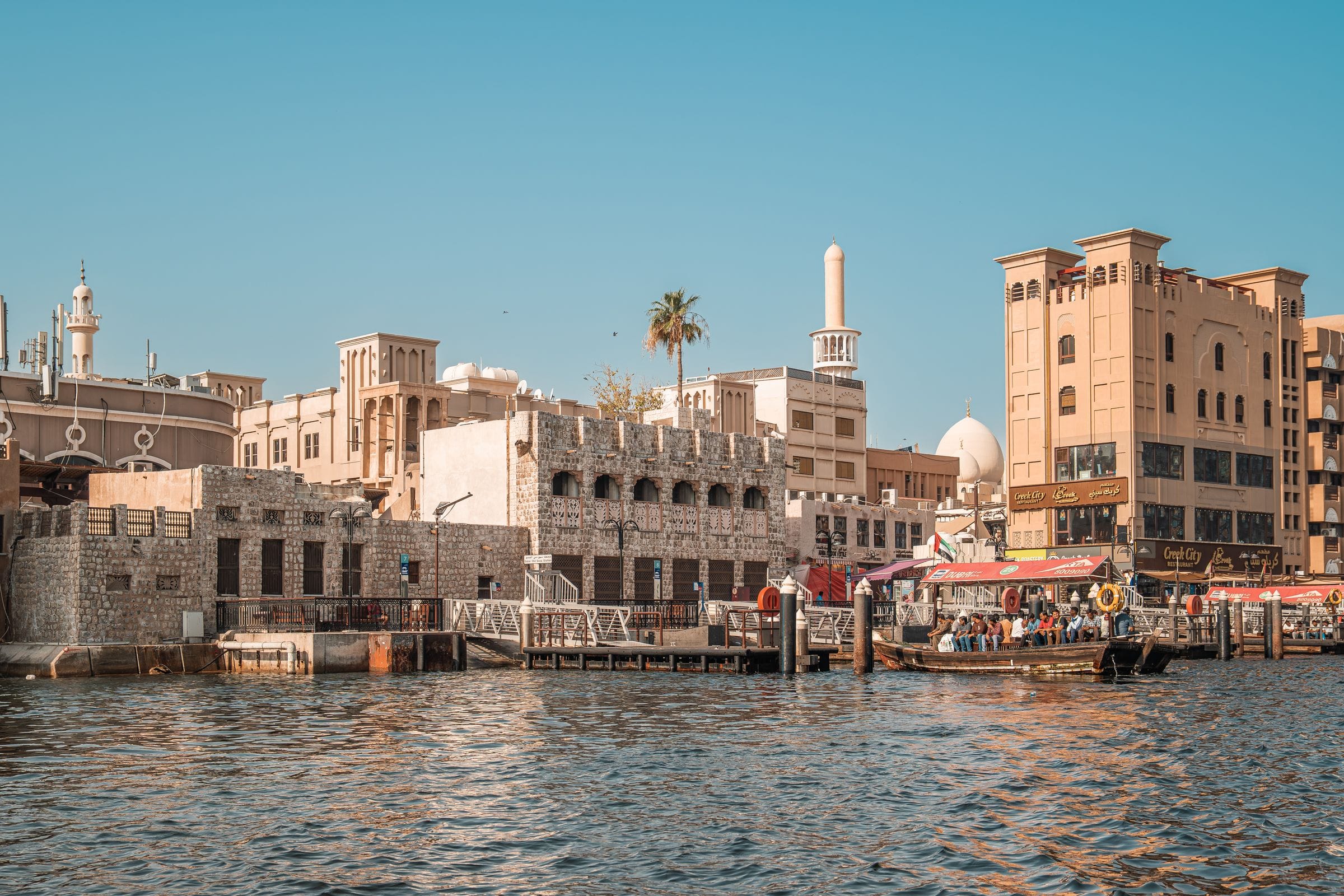
You can still see the traces. The Al Fahidi (Bastakiya) quarter with its wind towers was built by settlers from southern Persia. I show it on my Old Dubai tour, and there’s more on the city’s early years in my history of Dubai.
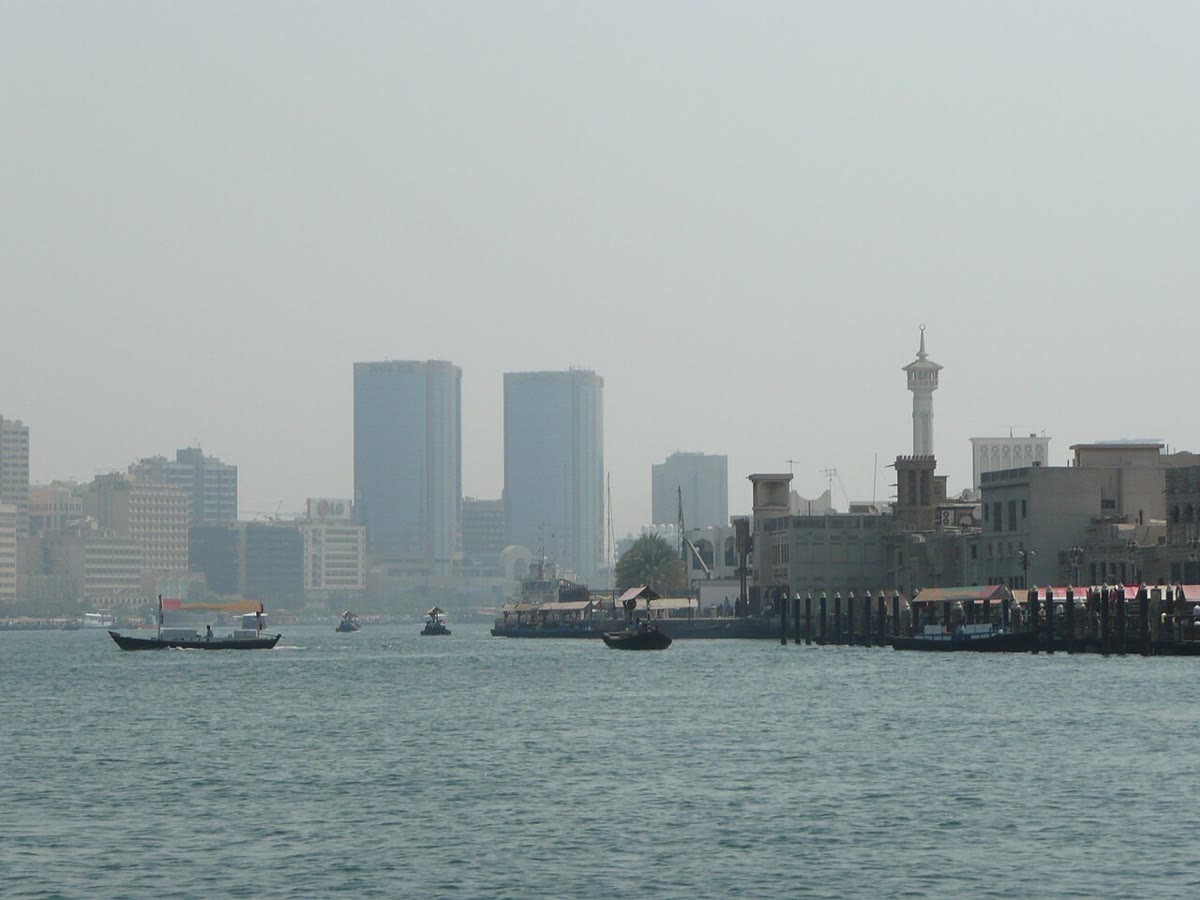
Dubai Creek, the port where trading Dubai began. Photo: CT Cooper, public domain, Wikimedia Commons.
1959: a loan to dredge the Creek
By the 1950s Dubai Creek was silting up, and large ships couldn’t get in. Sheikh Rashid bin Saeed went to Kuwait, which was already exporting oil, and took out a large loan. Sources give figures from 400,000 to 500,000 pounds. In 1958–1959 the Creek was dredged, and ships of up to 500 tonnes could reach the city.
For a small emirate this was a huge risk: borrowing against trade that didn’t exist yet. But that logic, build first and wait for the customers, would become Dubai’s signature.
Ports and the free zone: Port Rashid, Jebel Ali, Jafza
Then the scale grew. Deep-water Port Rashid opened in 1972. Within a few years it was clear that wasn’t enough either. On 26 February 1979 Queen Elizabeth II opened Jebel Ali port, 40 km from the old town. It’s called the world’s largest man-made harbour, and at the time many thought it was too far away and far too big.
In 1985 the Jebel Ali Free Zone (Jafza) opened next to the port. It started with 19 companies. Today there are more than 11,000. The core idea of free zones is no limits on foreign ownership: a foreigner can own a company outright, with no local partner. The rest of the country only adopted that rule for most types of business in 2021; the free zones had lived that way for decades.
According to DP World, marking the zone’s 40th anniversary, Jafza attracted more than 30 billion dollars of foreign investment over 20 years and, together with the port, created more than a million direct and indirect jobs.
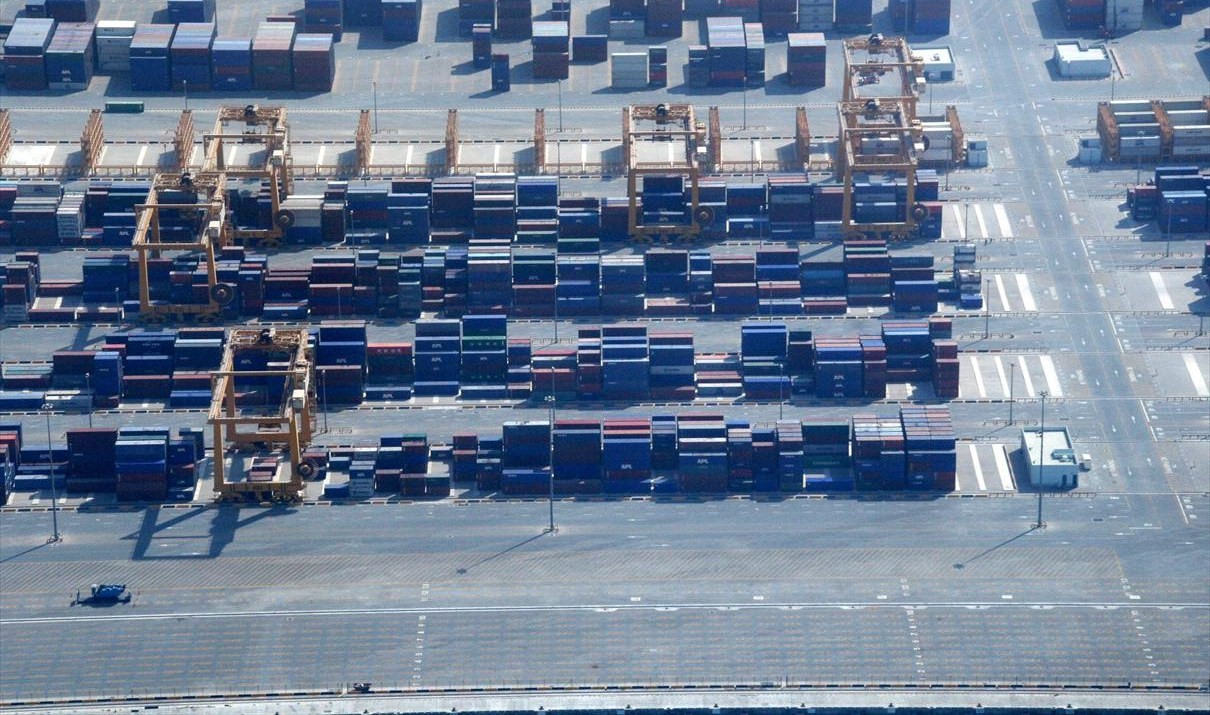
The Jebel Ali container terminal. The port opened in 1979, the free zone next to it in 1985. Photo: Imre Solt, CC BY-SA 3.0, Wikimedia Commons.
Emirates: an airline as an economic tool
Emirates was born in the same year, 1985. Its start-up capital was 10 million dollars. It had no planes of its own: the first aircraft were leased from Pakistan International Airlines. The first flight left for Karachi on 25 October 1985.
Today it’s a different scale. In the 2025–26 financial year Emirates carried 53.2 million passengers, with 277 aircraft and a network of 152 cities in 80 countries. DXB handled 95.2 million passengers in 2025, which Dubai Airports says is a record for international traffic at any airport in the world.
The point is that Dubai turned geography into a business. The city is a few hours’ flight from a huge share of the world’s population, and the airline turned that into a flow of people: tourists, business travellers, transit passengers. Many first see the city on a stopover, and for them I have a separate guide to Dubai on a layover.
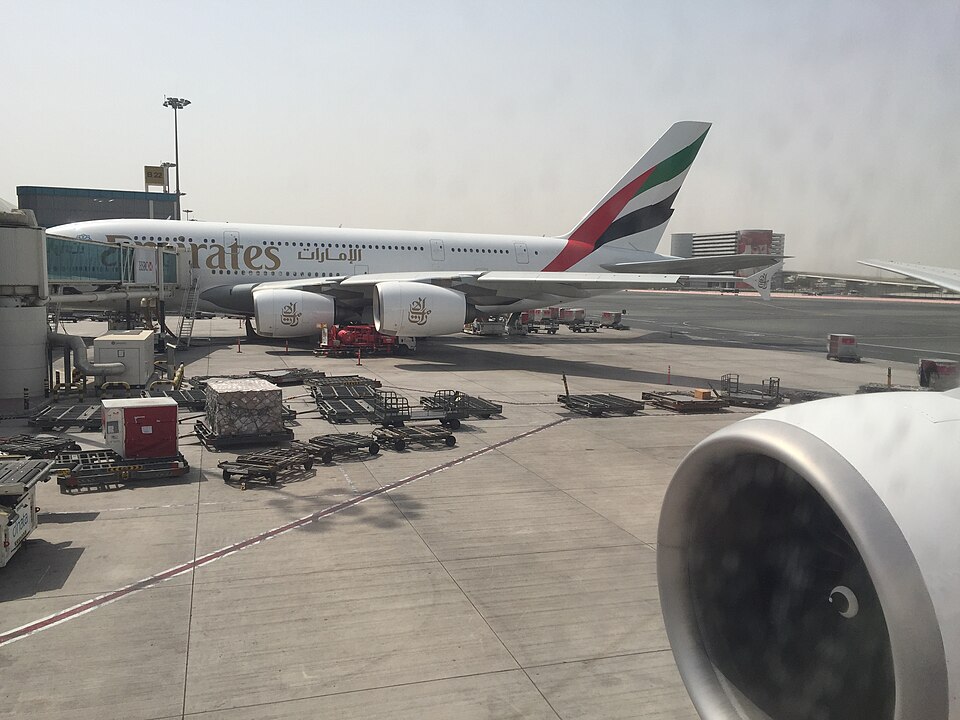
An Emirates A380 at a gate at DXB. The airline started in 1985 with two leased planes. Photo: Sunnya343, CC BY-SA 4.0, Wikimedia Commons.
Build before demand
This rule repeats itself throughout Dubai’s history. In 1979 the Dubai World Trade Centre opened: 39 floors, the tallest building in the Middle East. People complained it was “impossibly far from the city”. Today it’s right in the centre, with Sheikh Zayed Road and its business towers stretching south from it.
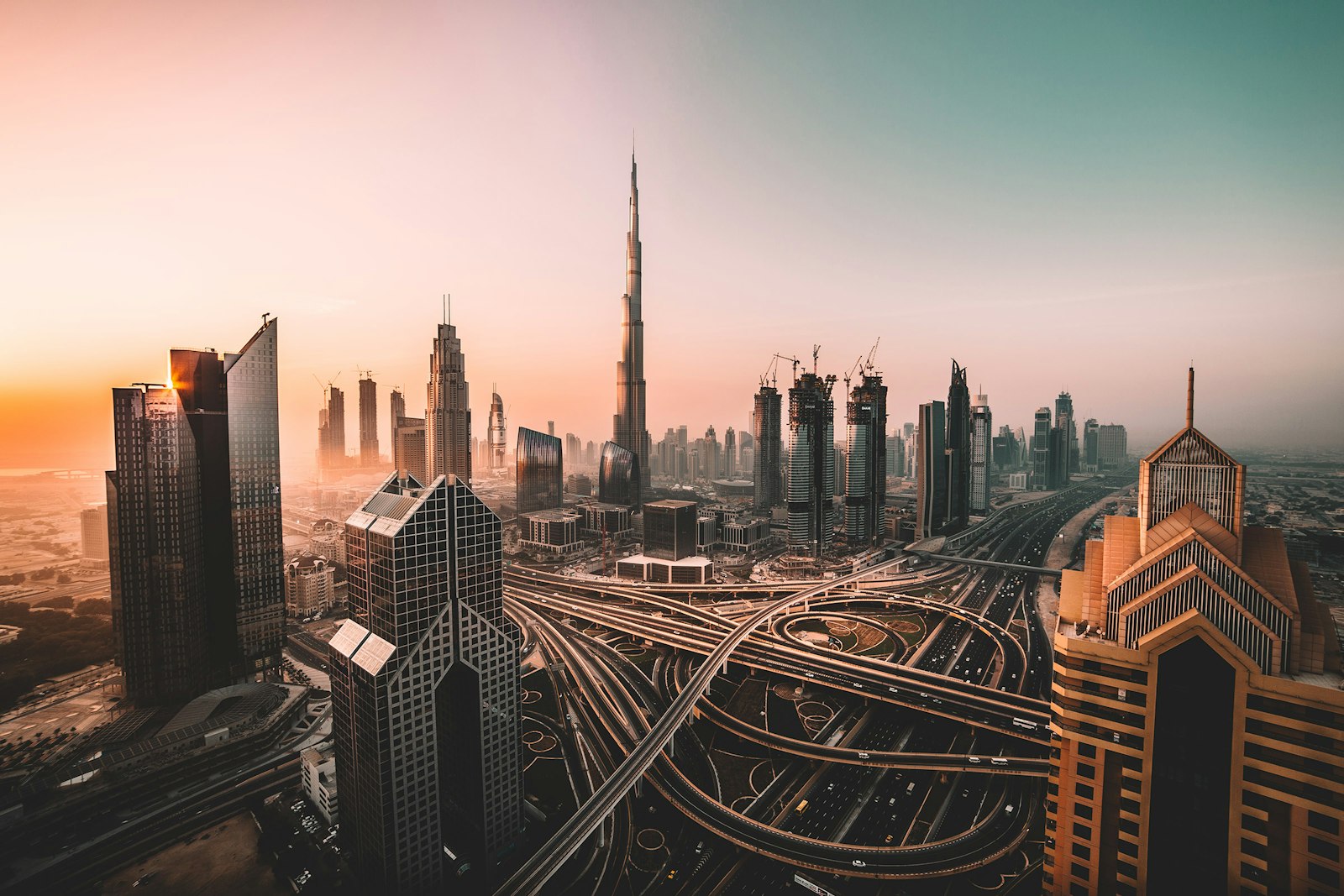
Burj Khalifa opened on 4 January 2010: 828 metres, the world’s tallest building according to Guinness World Records. The tower, Palm Jumeirah and the islands aren’t just real estate. They’re advertising. Megaprojects make a city recognisable without an ad budget: people film them, write about them and fly in to see them.
Tourism as a strategy
Burj Al Arab opened on 1 December 1999. The sail-shaped hotel became a symbol of Dubai before the city became a mass destination. It was a statement: “This place is worth the flight.”
Today tourism is one of the economy’s pillars. In 2025 Dubai welcomed 19.59 million international overnight visitors, the third record year in a row. The city has more than 154,000 hotel rooms, with average occupancy of 80.7%. All of it, Downtown, Burj Khalifa, the Palm and the old town, is on my Dubai sightseeing tour.
Rules for other people’s money: freehold and DIFC
In May 2002 foreigners were first allowed to buy homes outright in designated areas of Dubai. A 2006 property registration law made it official. Before that, a foreigner could at best hope for a long lease. The market that grew from this decision is now one of the city’s biggest draws, and also its most volatile, as you’ll see below.
In 2004 the Dubai International Financial Centre (DIFC) was set up. Its key feature is its own courts, which work in English under common law on the English model. For international business, those are rules of the game it understands. In 2025 the DIFC had 8,844 active companies and 50,200 employees.
Then there’s the tax system: the UAE has no personal income tax, federal or emirate. There is corporate tax and VAT, though, so “no taxes at all” is a myth.
People and safety
Dubai is a city of newcomers. At the end of 2025 it had 4.58 million residents, 7.5% more than a year earlier. During the day there are about 6.4 million people in the city on average, including those who come in to work or visit. People of more than 200 nationalities live in the UAE, and in Dubai you feel it on every street.
The sense of safety here isn’t marketing. In summer 2025 I left a backpack with my laptop at the airport entrance, and ten days later Dubai Police found it, with everything inside untouched. In December the same year I filmed Dubai’s first driverless police boat. The police here love new technology.
The numbers back it up. In Numbeo’s ranking as of mid-2026, the top four places went to UAE cities: Ajman, Abu Dhabi, Ras Al Khaimah and Sharjah. Dubai is sixth. The ranking is based on residents’ surveys of how safe they feel, but for families choosing where to live, it’s a strong argument.
2009: the downside of fast growth
It wouldn’t be honest to talk only about success. The build-before-demand model runs on borrowed money, and in 2009 that became visible. During the global crisis, in November 2009, the state holding company Dubai World asked creditors to delay payments. On 14 December Abu Dhabi put 10 billion dollars into Dubai’s financial support fund, and 4.1 billion of it went straight to repaying Islamic bonds issued by the developer Nakheel. Property prices fell and bottomed out in 2009–2011.
The city came through and learned from it, but the lesson stuck: Dubai’s property market rises fast and can fall just as fast.
The next big showcase was Expo 2020. Because of the pandemic it ran from October 2021 to March 2022: 24,102,967 visits over 182 days, with 192 participating countries.
What’s next: the D33 plan
On 4 January 2023 Sheikh Mohammed bin Rashid announced the D33 economic agenda. The goal is to double Dubai’s economy in ten years and secure a place among the world’s top three cities. The plan has 100 projects and economic targets worth 32 trillion dirhams over the decade. How it fits into the national plans is in my post on the UAE’s visions for 2031 and 2071.
What you can see on a tour
Dubai’s success story is easiest to see in two parts:
- The old town: the Creek, abras, Shindagha, Bastakiya, the Deira souks. This is the Dubai of merchants and the free port. If you’d like to walk it yourself, here’s my Old Dubai walking route.
- The new city: Sheikh Zayed Road, Downtown, Burj Khalifa, the Palm. This is the Dubai that was built before the demand.
I usually suggest starting in the old town and then heading to the new city. That way you see a hundred years of difference in a single day.
How I can help
I run private tours of Dubai with hotel pick-up and tell this story on the spot: where the first merchant houses stood, what the Creek looked like before dredging, why the World Trade Centre was once seen as a building site “in the desert”. The Old Dubai tour and the Dubai sightseeing tour both work for this. I can also book tickets for Burj Khalifa and other observation decks.
Send me your dates and how many of you there are, and I’ll suggest a route.
Checked on 11 October 2026. Sources: Dubai Media Office (GDP, tourism, airport, DIFC, Expo 2020, D33), DP World and Gulf News (Jafza, Jebel Ali, Emirates), PwC Worldwide Tax Summaries, Guinness World Records, The National and the Sultan Al Qasimi archive (Creek dredging), Wikipedia citing Lorimer’s gazetteer and Graeme Wilson’s “Father of Dubai” (free port).
Practical answers
Frequently asked questions
Is Dubai rich because of oil?
No. Today oil accounts for less than 1% of Dubai's GDP. The biggest sectors are wholesale and retail trade, transport and logistics, finance and real estate. It's neighbouring Abu Dhabi that is rich in oil.
When did Dubai start growing fast?
In waves: in the early twentieth century Dubai became a free port and drew in merchants; in 1958–1959 the Creek was dredged; in the 1970s Port Rashid and Jebel Ali opened; in 1985 came the free zone and Emirates airline; and in the 2000s freehold for foreigners and the DIFC financial centre.
Why is there no income tax in Dubai?
The UAE has no federal or emirate-level personal income tax. The budget relies on fees, duties, 5% VAT and corporate tax on businesses. Rules change, so check your own situation with a tax adviser.
What happened to Dubai in 2009?
The global crisis hit the debt of state companies: in November 2009 Dubai World asked creditors to delay payments. On 14 December Abu Dhabi provided 10 billion dollars, 4.1 billion of which went to repay a Nakheel sukuk. Property prices bottomed out in 2009–2011.
How many people live in Dubai?
According to Dubai's statistics centre, 4.58 million at the end of 2025, 7.5% more than a year earlier. During the day there are about 6.4 million people in the city on average, counting those who come in.
Where in Dubai can you see where it all began?
On Dubai Creek: Al Fahidi, Shindagha, the Deira souks and the abra crossing. That's the route of my Old Dubai tour.