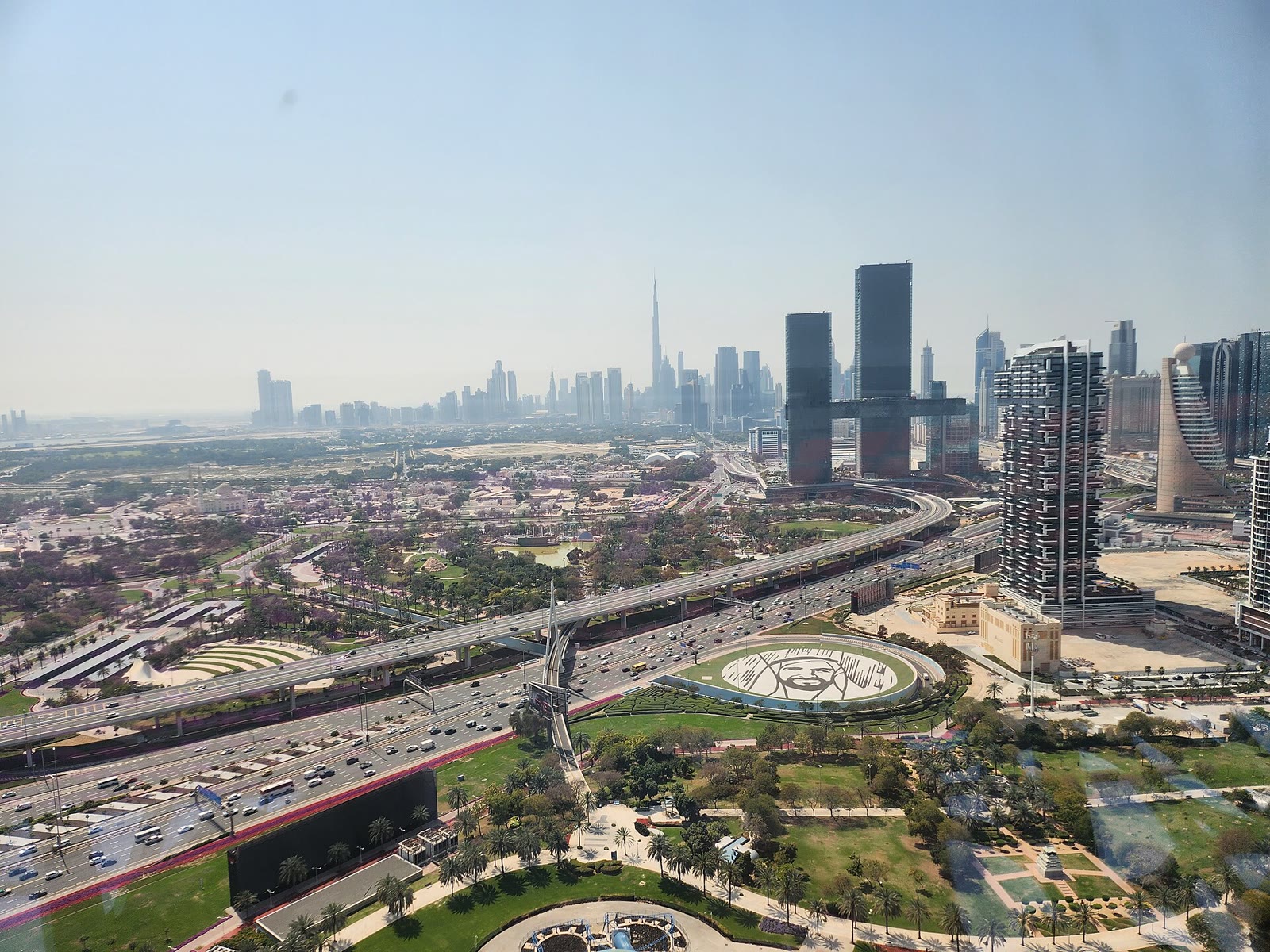
Guests often ask me in the car: “So what’s next? Where else is there to grow?” It’s a fair question. Dubai has already built the world’s tallest building, Abu Dhabi the Louvre and Sheikh Zayed Grand Mosque. But the Emirates have a habit that surprises many people: they publish plans 10, 30 and even 50 years ahead, with numbers and dates. And then they report against them.
In this post I’ve gathered the UAE’s main strategies in plain English, from official sources only. At the end I’ll tell you what you can already see for yourself on an ordinary trip.
In short: five horizons
| Horizon | Plan | Main goal |
|---|---|---|
| 2030 | Abu Dhabi Economic Vision 2030 | Depend less on oil |
| 2031 | We the UAE 2031 | Double national GDP to 3 trillion dirhams |
| 2033 | Dubai D33 | Double Dubai’s economy, join the world’s top 3 cities |
| 2050 | Net Zero 2050 | Net zero emissions |
| 2071 | UAE Centennial 2071 | The best country in the world by the union’s 100th anniversary |
If you haven’t yet worked out how the Emirates themselves fit together, start with my guide to the seven emirates: Dubai and Abu Dhabi have their own plans, with a federal one above them.
We the UAE 2031
This is the ten-year national plan. It was adopted on 22 November 2022 at the UAE Government Annual Meetings. It rests on four pillars: society, the economy, diplomacy and the government “ecosystem”, meaning how government works and the infrastructure behind it, digital included.
Numbers worth remembering:
- GDP: grow from 1.49 to 3 trillion dirhams;
- non-oil exports: 800 billion dirhams;
- tourism: 450 billion dirhams of GDP;
- foreign trade: 4 trillion dirhams.
Beyond money, the plan has rankings: a place in the world’s top ten for the Human Development Index and healthcare quality, and first place on the safety index. For a tourist that sounds abstract, but guests usually notice the last one on their first evening.
UAE Centennial 2071
This is the furthest horizon. The union of emirates was formed in 1971 (more in how the UAE was formed), so in 2071 the country turns a hundred. The goal is boldly put: make the UAE the best country in the world by then.
The plan was launched by Sheikh Mohammed bin Rashid Al Maktoum, Vice President and Prime Minister of the UAE and Ruler of Dubai. It was based on a lecture by Sheikh Mohamed bin Zayed, then Crown Prince of Abu Dhabi. Its four pillars:
- a government that thinks decades ahead;
- education focused on science, technology and entrepreneurship;
- a diversified knowledge economy;
- a happy, cohesive society that is safe and tolerant.
You’ll see the year 2071 in Dubai quite literally: the Museum of the Future’s exhibition is built as a journey to 2071. I went through it in March 2022, a few weeks after it opened: it all starts with a flight to a space station, and in the future it shows, the skyscrapers are even taller and there are even more artificial islands. The “cleaners” of 2071, though, didn’t quite convince me.
Dubai D33: doubling the economy in ten years
Sheikh Mohammed bin Rashid announced Dubai’s D33 economic agenda on 4 January 2023. Why 33? In 2033 Dubai turns 200, which I cover in my history of Dubai.
The main D33 goals:
- double the size of Dubai’s economy in ten years;
- become one of the world’s top three cities;
- 100 transformative projects and economic targets of 32 trillion dirhams over the decade;
- foreign trade from 14.2 to 25.6 trillion dirhams, plus 400 new partner cities;
- 650 billion dirhams of foreign direct investment over ten years;
- digital transformation adding an average of 100 billion dirhams of value a year;
- a place among the world’s top four financial centres and top three destinations for tourism and business;
- jobs for 65,000 young Emiratis.
If you’re thinking about moving here or doing business, that’s an important signal: the city has said publicly where it plans to grow, in trade, finance, logistics, the digital economy and tourism.
Abu Dhabi: life after oil
The capital has its own plan, the Abu Dhabi Economic Vision 2030. Its essence is to gradually reduce the economy’s dependence on oil and build on knowledge-based industries. Its priorities include an open business environment, disciplined fiscal policy, an efficient labour market, infrastructure, a skilled workforce and financial markets.
What does that look like in numbers? The Statistics Centre Abu Dhabi reported that in the first quarter of 2025 the non-oil sector made up 56.2% of the emirate’s GDP, more than half.
You can see Abu Dhabi’s diversification in the Cultural District on Saadiyat Island, home of the Louvre; more in my post on Louvre Abu Dhabi with a guide. Another example is Masdar City, an eco-city under construction since 2006. It’s home to the headquarters of IRENA, the International Renewable Energy Agency, and to the Mohamed bin Zayed University of Artificial Intelligence. Petrol cars don’t drive into the centre; they’re left at the edge of town.
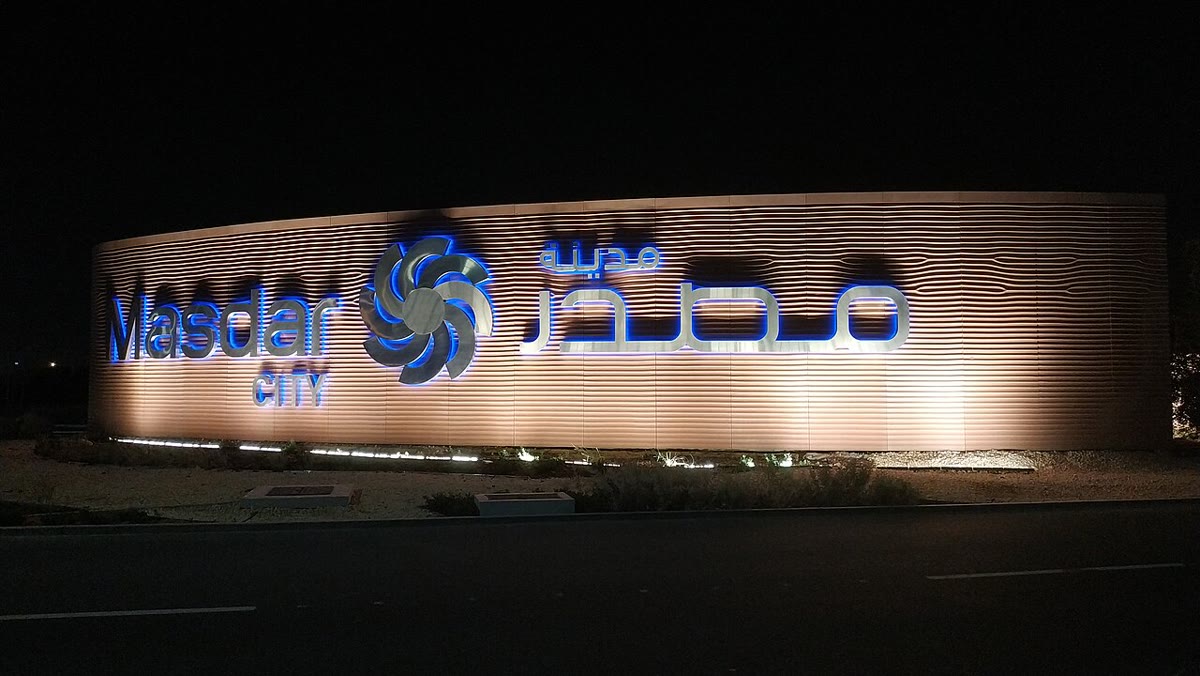
Masdar City in Abu Dhabi, a district built as a showcase for clean energy. Photo: Renek78, CC BY-SA 4.0, Wikimedia Commons.
Net Zero 2050: an oil country going to zero
On 7 October 2021, at Expo 2020, the UAE announced the Net Zero 2050 strategic initiative: net zero emissions by 2050. The Emirates became the first country in the Middle East and North Africa with such a target. Sheikh Mohammed bin Rashid said then that the country would invest more than 600 billion dirhams in renewable energy.
It’s not just words. IRENA’s headquarters are in the UAE, and in 2023 Expo City Dubai hosted the UN climate summit, COP28.
Artificial intelligence: the first AI minister
In October 2017 the UAE government adopted its Artificial Intelligence Strategy. That same month Omar Sultan Al Olama became Minister of State for Artificial Intelligence, the first such post in the world. Today the title is broader: Minister of State for AI, Digital Economy and Remote Work Applications. The strategy’s horizon is 2031: to be among the world’s leading countries in AI.
A tourist notices the digital state in small things: many services, from parking to government services, have long run through apps here.
Emiratisation: jobs for citizens
Emiratisation is the programme through which the state gradually brings UAE nationals into the private sector. The rules as of October 2026, according to the u.ae portal:
- companies with 50 or more employees raise the share of Emiratis in skilled roles by 2% every year;
- the overall target is 10% by the end of 2026;
- companies with 20–49 employees in 14 sectors, including IT, healthcare, construction and hospitality, must hire at least one national;
- a company that falls short pays a monthly contribution for each unfilled position;
- the Nafis programme helps with hiring and training.
If you’re moving here for a job, it’s worth knowing: Emiratisation shapes a company’s hiring policy, not your personal contract. Contribution amounts and sector lists change, so check them on the website of the Ministry of Human Resources and Emiratisation (MOHRE).
Space: from Hope to the ISS
The most spectacular part of the strategies is space. On 20 July 2020 the Hope Probe launched from Japan’s Tanegashima Space Center. It was the Arab world’s first interplanetary mission. On 9 February 2021 it entered Mars orbit, just in time for the UAE’s 50th anniversary. The project was led by the Mohammed bin Rashid Space Centre (MBRSC) in Dubai.
The UAE has its own astronauts too. Hazzaa Al Mansoori flew to the ISS on 25 September 2019. Sultan Al Neyadi launched on 2 March 2023 and spent six months on the station.
Tolerance and the Abrahamic Family House
The UAE government has a Minister of Tolerance and Coexistence. On 4 February 2019, in Abu Dhabi, Pope Francis and the Grand Imam of Al-Azhar, Ahmed el-Tayeb, signed the Document on Human Fraternity. The Abrahamic Family House on Saadiyat Island grew out of that meeting.
It’s three buildings in one complex: the Imam Al-Tayeb Mosque, St. Francis Church and the Moses Ben Maimon Synagogue. Designed by the architect David Adjaye, it was inaugurated in February 2023 and opened to the public on 1 March 2023. Entry is free. In December 2023 I brought guests here: a Catholic church, a mosque and a synagogue around one courtyard impress even people who feel they’ve seen everything in the Emirates. The complex stands in the same Saadiyat Cultural District as the Louvre, and it’s easy to fit into an Abu Dhabi day trip.
The legacy of Expo 2020
The Expo 2020 world fair ran in Dubai from 1 October 2021 to 31 March 2022. According to the Dubai Media Office, it recorded 24,102,967 visits over 182 days, with 192 participating countries. On 1 October 2022 the site reopened as Expo City Dubai, a new city district with parks, pavilions and museums. The Red Line of the metro runs there, to Expo 2020 station.
You can see how proud the country is of these projects even in its money. In January 2024 an exchange office handed me a new 500 dirham note I’d never seen before. Even the ATM wouldn’t take it. One side shows the Terra pavilion from Expo 2020, the other the Museum of the Future and Burj Khalifa. The new polymer 500 note came into circulation at the end of 2023.
What a visitor can already see
The nicest thing about the UAE’s strategies is that you can touch a lot of them:
- The Museum of the Future opened on 22 February 2022 on Sheikh Zayed Road. The building is 77 metres tall, and its facade of 1,024 panels is covered in Arabic calligraphy with lines from Sheikh Mohammed’s poetry. Inside is a journey to 2071. Not everyone loves the exhibition, but I’ve never met anyone indifferent to the building from outside. In autumn 2022, the museum’s first season, the earliest tickets on the official site were a month away, so in high season buy them in advance.
- Etihad Rail. The first passenger trains ran from Fujairah to Abu Dhabi on 30 June 2026. Since 30 September 2026 trains have run between Abu Dhabi and Dubai, 10 services a day. Dubai’s Al Yalayis station is linked by a footbridge to Jumeirah Golf Estates metro station on the Red Line. A Sharjah station is promised for March 2027.
- The Dubai Metro. The Blue Line is under construction: 30 km and 14 stations, with opening set for 9 September 2029. For the metro as it is now, see my post on getting around Dubai.
- Masdar City, Expo City Dubai, the Abrahamic Family House: you can see all of them on an ordinary trip if you plan the day well.
This is how it usually looks in my plans:
- A day in Dubai. Sheikh Zayed Road past the Museum of the Future, the business district, the metro, the Palm, the Marina, and in the evening Burj Khalifa and the fountains. My Dubai sightseeing tour follows this logic, and the museum itself can be added with a separate ticket.
- A day in Abu Dhabi. Sheikh Zayed Grand Mosque, the Louvre or Qasr Al Watan, Saadiyat Island. From Dubai it takes 7–8 hours. The programme is on my Abu Dhabi day tour page.
If you’re curious what the UAE spends its money on outside the country, read my post on what the UAE owns abroad.
How I can help
I run private tours of Dubai and Abu Dhabi with hotel pick-up, and I tell the country’s story the way it sees itself: from fishing villages to Mars. I can book tickets for the Museum of the Future, the Louvre and Qasr Al Watan, and put together a day where history and the future come in the right order.
If you’re coming to look at the country before moving or investing, I’ll show you the neighbourhoods and explain how life works here. I don’t handle visas, company set-up or bank accounts.
This isn’t legal or investment advice: rules and prices change, so check them before any deal.
Checked on 11 October 2026. Sources: u.ae, Dubai Media Office, Abu Dhabi Media Office, MBRSC, MOHRE, Gulf News.
Practical answers
Frequently asked questions
What is We the UAE 2031?
The UAE's ten-year national development plan, adopted on 22 November 2022. The headline goal is to double GDP from 1.49 to 3 trillion dirhams, and to take non-oil exports to 800 billion, tourism's contribution to GDP to 450 billion and foreign trade to 4 trillion dirhams.
What does D33 mean in Dubai?
D33 is Dubai's economic agenda to 2033, announced on 4 January 2023. The goal is to double the emirate's economy in ten years and become one of the world's top three cities. The year 2033 isn't random: it marks 200 years since Dubai was founded.
What is UAE Centennial 2071?
The country's longest planning horizon: to make the UAE the best country in the world by 2071, when the union turns 100. The plan has four pillars: government, education, a diversified knowledge economy and a happy, cohesive society.
What is Emiratisation and does it affect expats?
A programme to bring UAE nationals into private-sector jobs. Companies with 50 or more employees must raise the share of Emiratis in skilled roles by 2% a year, aiming for 10% by the end of 2026. It affects expats indirectly, through their employer's hiring policy.
Can you take a train from Dubai to Abu Dhabi?
Yes, since 30 September 2026. Etihad Rail carries passengers between Al Yalayis station in Dubai and Mohamed bin Zayed City in Abu Dhabi, 10 services a day. Check timetables and fares in the Etihad Rail app or on its website before you travel.
Where can a visitor see the UAE's future for themselves?
Most easily at the Museum of the Future on Sheikh Zayed Road, Expo City Dubai, Masdar City and the Abrahamic Family House in Abu Dhabi. I talk about these plans on my sightseeing tours of Dubai and Abu Dhabi.


