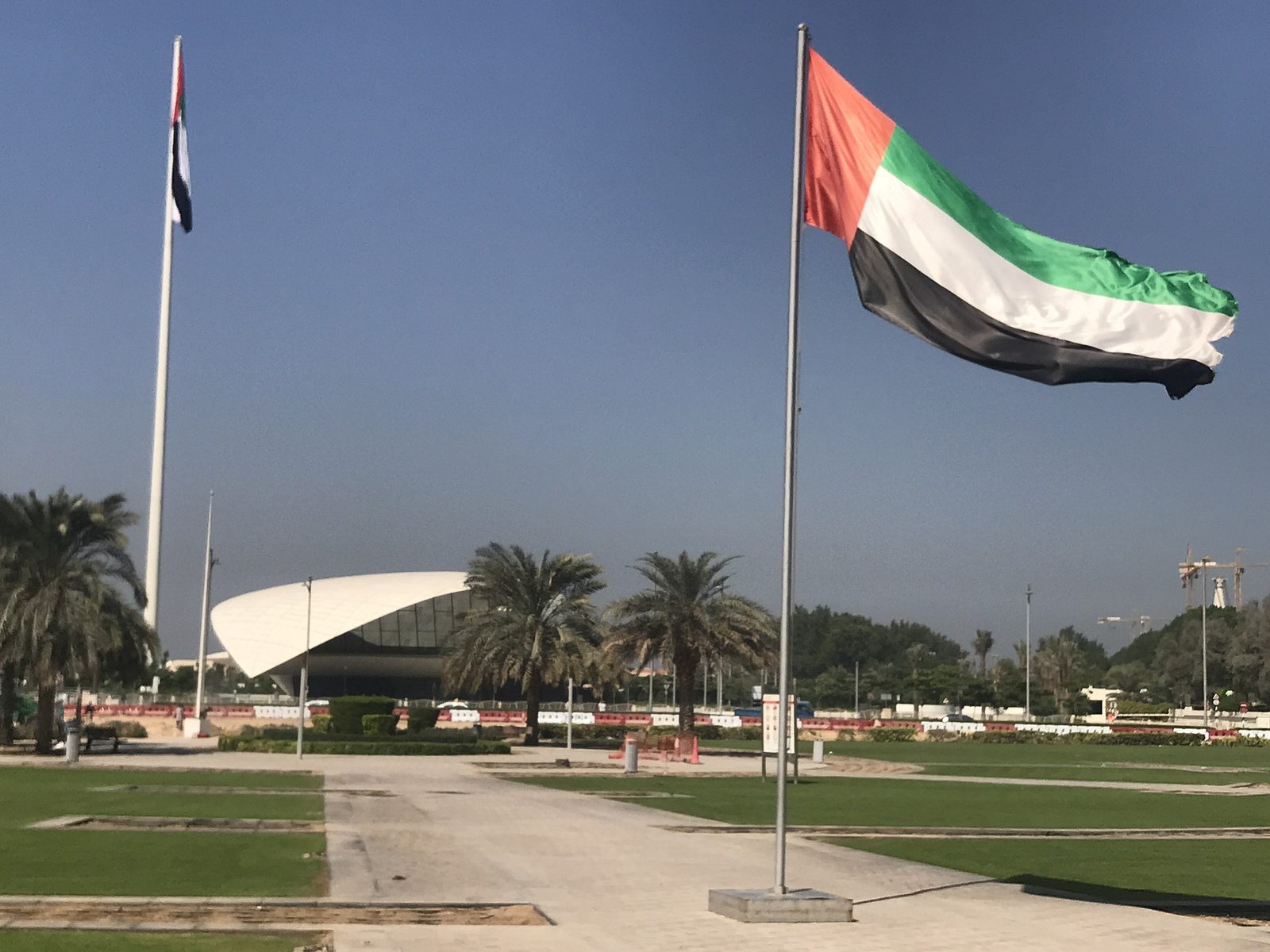
When we drive along Jumeirah Street, guests almost always ask about the huge flag on a flagpole by the sea. Beneath it stands a low, round house you could easily take for an old villa. This is where, on 2 December 1971, the country you flew into was born. And it was born very recently: many people who remember that day are still alive.
This post is about how seven separate sheikhdoms became one country, from the British treaties of the 19th century to a flag drawn by a 19-year-old student.
The short timeline
- 1820: the General Maritime Treaty with Britain.
- 1853: the Perpetual Maritime Truce; the coast becomes known as the Trucial Coast.
- 1892: the Exclusive Agreement hands the sheikhdoms’ foreign affairs to Britain.
- 1952: the first meetings of the Trucial States Council.
- January 1968: Britain announces it is leaving the Gulf.
- 18 February 1968: Sheikh Zayed and Sheikh Rashid agree on a union of Abu Dhabi and Dubai.
- 18 July 1971: the rulers of six sheikhdoms sign the agreement creating the UAE in Dubai.
- 2 December 1971: the UAE is proclaimed and Sheikh Zayed is elected President.
- 10 February 1972: Ras Al Khaimah becomes the seventh emirate.
The Trucial Coast: how Britain came to the Gulf
In the early 19th century the British fought the local rulers at sea, then swapped war for treaties. The General Maritime Treaty was signed in Ras Al Khaimah on 8 January 1820. In 1853 the rulers agreed the Perpetual Maritime Truce: they gave up war at sea, and Britain promised to protect them from attack by sea. Because of that truce, the British began calling the sheikhdoms the Trucial States and the coast the Trucial Coast.
In March 1892 came the Exclusive Agreement. The rulers promised to deal only with Britain and not to cede territory to anyone else. Formally it wasn’t a protectorate: each sheikh ran his own internal affairs. But London ran the Trucial States’ foreign policy.
What the coast lived on in those years, pearls, fish, dates and trade, is the subject of my post on the UAE before oil.
The Trucial States Council
In 1952 the rulers began meeting in a joint council to discuss administrative questions together. It wasn’t a state yet, but the rulers were getting used to negotiating around one table. Fujairah, previously counted as part of Sharjah, became the seventh Trucial State.
Once the first oil tanker left Abu Dhabi in 1962, the future country had money. When Sheikh Zayed became ruler of Abu Dhabi in 1966, the emirate became the biggest contributor to the joint development fund. More about him in Sheikh Zayed: the man who built a country.
1968: Britain leaves
On 16 January 1968 British Prime Minister Harold Wilson announced that British forces would withdraw from “east of Suez”, including the Gulf. For the small sheikhdoms this was a challenge: the protection would end, and each of them alone was too small.
Sheikh Zayed went to Dubai to see Sheikh Rashid bin Saeed Al Maktoum. On 18 February 1968 the two rulers agreed on a union of Abu Dhabi and Dubai and invited the others to join. At first a larger federation of nine sheikhdoms was discussed, including Qatar and Bahrain. In the end those two chose independence of their own.
1971: six signatures
On 18 July 1971 the rulers of six Trucial States, Abu Dhabi, Dubai, Sharjah, Ajman, Umm Al Quwain and Fujairah, signed the agreement in Dubai creating the United Arab Emirates. On 1 December the old treaties with Britain were terminated.
On 2 December 1971 the rulers met in a guest palace on the shore in Jumeirah. Built in 1965, it is now called Union House. Here they signed the declaration creating the state and the provisional constitution. Twenty-one people attended; for Britain, Sir Geoffrey Arthur signed a Treaty of Friendship with the new country. The rulers unanimously elected Sheikh Zayed as President, and Sheikh Rashid became Vice President.
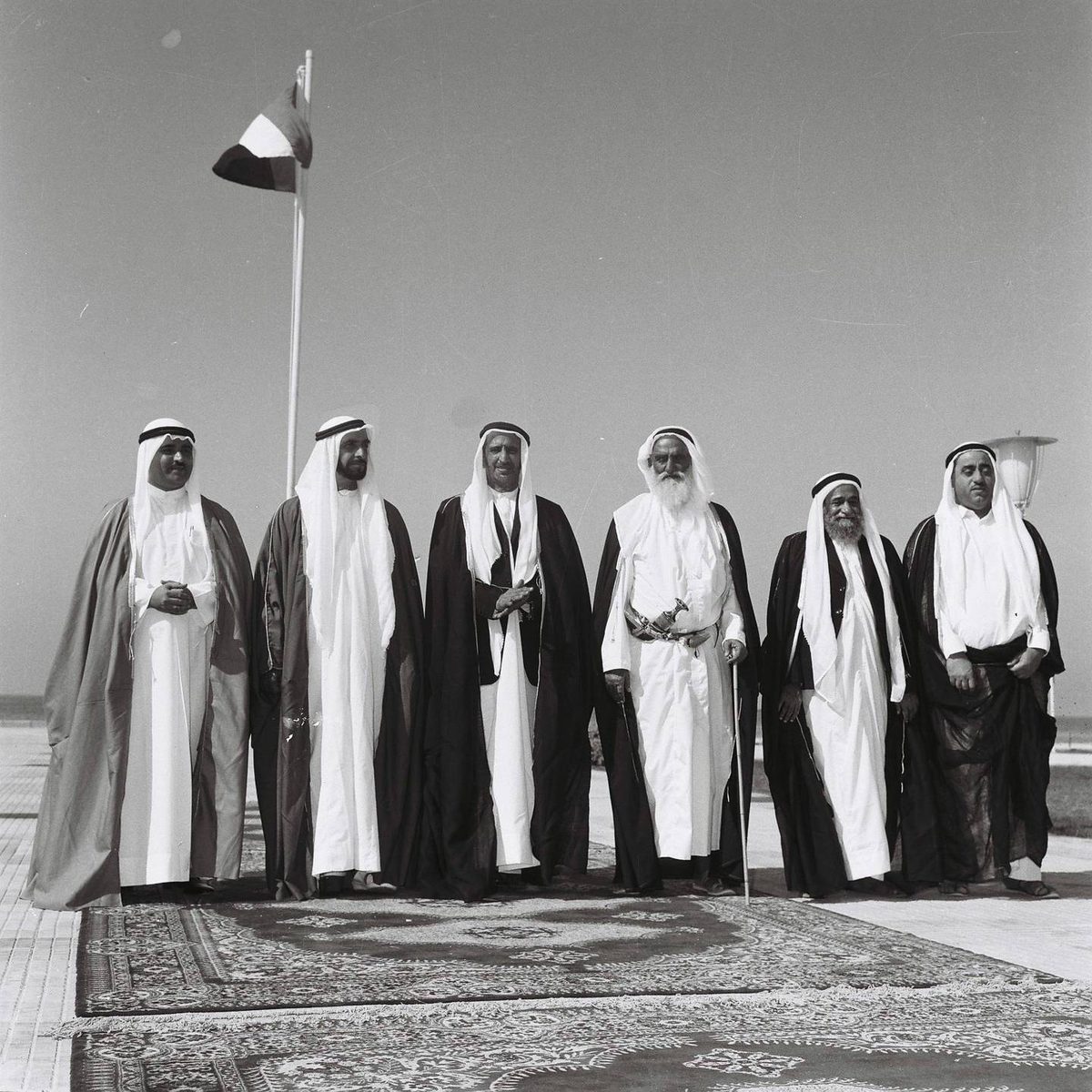
2 December 1971 at Union House: Sheikh Zayed with the rulers of Sharjah, Dubai, Ajman and Fujairah, and the Crown Prince representing Umm Al Quwain. Photo: Noor Ali Rashid, public domain, Wikimedia Commons.
Everyone in the Emirates knows these photos from 1971 and 1972: around the country’s birthday they are everywhere. In May 2023 I shared the original pictures of the union signing and of Ras Al Khaimah joining on my Instagram. Guests are often surprised by how recent it all is: the country is only just over half a century old.
The seventh emirate: Ras Al Khaimah
Ras Al Khaimah didn’t sign the union straight away in 1971. Its ruler, Sheikh Saqr bin Mohammed Al Qasimi, sought guarantees over disputed islands in the Gulf. After negotiations, on 10 February 1972, Ras Al Khaimah joined the federation, and there were seven emirates. That gave the country the shape we know today.
A flag drawn by a student
The UAE flag was designed by Abdullah Mohammed Al Maainah. In 1971 he was 19. He saw the competition notice in Al Ittihad newspaper a few days before the deadline and beat more than 10,000 entrants. He found out he had won when he saw his flag raised on 2 December 1971, watching from behind the fence of Al Mushrif Palace in Abu Dhabi.
The colours are usually explained like this:
- green: fertility and prosperity;
- white: peace and tolerance;
- black: the strength of the people and of the land;
- red: courage and readiness to sacrifice for the country.
2 December: National Day
Every year on 2 December the UAE celebrates the day it was founded. In 2026 the country turns 55. Cities fill with flags, and in many places there are shows and fireworks. The giant flag on the 120-metre flagpole at Union House was raised on National Day 2001, for the union’s 30th anniversary.
If you’re in Dubai in early December, the programme of celebrations is usually announced close to the date. Check event schedules and road closures before you set out.
Where to see this history
- Etihad Museum, Dubai. It stands at the junction of Jumeirah Street and 2nd December Street. The outer shell of Union House, its windows and railings, has survived since 1971, and the interior has been restored to look as it did that day. According to the museum’s website it is open 10:00–20:00, last entry 19:00.
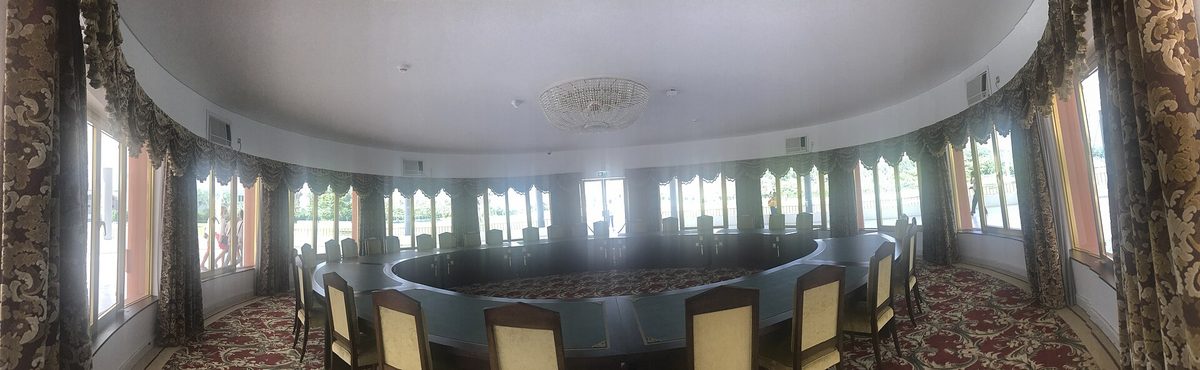
The room in Union House where the agreement creating the UAE was signed. Photo: Lxs, CC BY 4.0, Wikimedia Commons.
- Old Dubai. Al Shindagha, where Dubai’s ruling family lived, and Al Fahidi: I show both on my Old Dubai tour. For a route on your own, see my old Dubai walking route.
- Abu Dhabi. Qasr Al Hosn, where Sheikh Zayed was born, and the mosque that bears his name, both on my Abu Dhabi day tour.
- Al Ain. The city where Sheikh Zayed spent twenty years learning to govern, in my Al Ain day trip from Dubai.
How I can help
I run private tours of Dubai and Abu Dhabi with hotel pick-up, and I tell the country’s story along the way, between Union House, old Dubai and Sheikh Zayed Grand Mosque. If you’d like to see how a modern country grew out of seven sheikhdoms, send me your dates and I’ll put together a route for one day or several.
Checked on 11 October 2026. Sources: u.ae, UAE Ministry of Foreign Affairs, Etihad Museum website, The National, Gulf News.
Practical answers
Frequently asked questions
When was the UAE formed?
On 2 December 1971. That day six emirates, Abu Dhabi, Dubai, Sharjah, Ajman, Umm Al Quwain and Fujairah, declared the new state. Ras Al Khaimah joined on 10 February 1972.
Why is 2 December the UAE's National Day?
Because it is the day the country was founded. On 2 December 1971 the rulers signed the declaration of union and raised the new flag, so National Day is celebrated on that date.
Why were they called the Trucial States?
Because of the treaties with Britain. After the Perpetual Maritime Truce of 1853, the British called these sheikhdoms the Trucial States and the coast the Trucial Coast.
Where was the UAE founded?
In Dubai, in a guest palace on the shore in Jumeirah now known as Union House. Etihad Museum stands next to it.
Who designed the UAE flag?
Abdullah Mohammed Al Maainah. He was 19 in 1971: he saw the competition notice in a newspaper and beat more than 10,000 entrants. He first saw his flag raised on 2 December 1971.
Why did Ras Al Khaimah join the UAE later?
Its ruler, Sheikh Saqr, first sought guarantees over disputed islands in the Gulf. After negotiations, Ras Al Khaimah joined the federation on 10 February 1972.