A hundred years ago, where Dubai’s glass towers stand today, there were huts made of palm fronds, and the coast’s wealth lay on the seabed. I tell this story on almost every old town tour, and it always changes how people see the Emirates: a country known for oil lived without it for almost its entire history.
In Dubai Mall there is a waterfall with figures of divers. In autumn 2022 I showed it on my Instagram and explained that it refers to what local people did for a living right up to the 1930s. They say that if you look at one diver long enough, the others “disappear”. The effect has never worked for me, but the story behind those figures always does.
In short: how the Emirates lived before oil
- The sea fed the coast. Pearls, fish and sea trade were the main sources of income in the 19th and early 20th centuries.
- The oases fed the interior. Date palms were watered from aflaj, channels that have worked for thousands of years.
- Many families lived by the seasons. In summer the men went pearling; in winter they returned to the date gardens.
- Late 1920s to 1930s. The global depression and Japanese cultured pearls brought the trade down.
- 1962. The first tanker of oil left Abu Dhabi. From then on, it’s a different country.
Pearls: the coast’s great wealth
Gulf pearls were prized all over the world. The main season was called al-ghaus al-kabir, the great dive, and ran from 1 June to 30 September. Those are the hottest months of the year, and that is exactly when the men put to sea for four months. Shorter one-month seasons followed in October and November.
A large boat carried up to 30 men, and each had his role:
- nakhuda: the boat’s owner or his manager, who ran the business and divided the takings at the end of the season;
- serdal: the fleet captain and navigator, who knew where the best oyster beds lay;
- divers: they went under all day long for the shells;
- saib: the deck hand who lowered the diver on a rope and pulled him back up;
- tabbab: boys of 10–14, often sons of the crew, who helped the saib;
- nahham: the singer, whose songs and verses kept the crew’s spirits up through long months at sea.
The equipment was simple. A diver wore a fattam, a nose clip of tortoiseshell or bone. A stone tied to his foot took him down faster. A woven bag for the shells hung around his neck, and a signal rope let him tell the deck to pull him up.
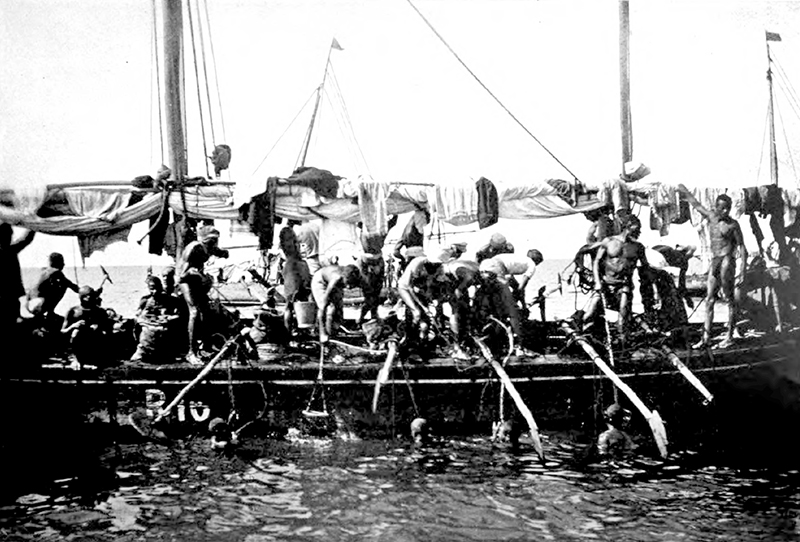
Pearl divers in the Gulf. Illustration from George Kunz, The Book of the Pearl, 1908. Public domain, Wikimedia Commons. Photo: George Frederick Kunz, public domain, Wikimedia Commons
The whole community saw the boats off from the shore. On the last day of the season a cannon fired from the beach: the boats would soon be home. Families hung out flags and made sweets, and the crews were greeted with songs, which they answered with their own. Just imagine four months on an open wooden boat in the hottest months of the year.
How the pearl economy collapsed
In the late 1920s and early 1930s two blows hit the coast at once. The global depression killed demand for luxuries. And Japanese cultured pearls turned out to be far cheaper than natural ones.
For the coast it was a disaster. People survived however they could: they dried fish on the sand and sold it as fertiliser, lived off what they could grow and catch, and hunger was never far away. It’s worth remembering when you look at Dubai today: between pearls and oil, the Emirates went through several very hard decades.
Dates and aflaj: life in the oases
While the coast lived from the sea, the interior lived from water. In the Al Ain oasis people have drawn water from the Hajar Mountains since the Iron Age, using the falaj, a system of underground and surface channels. The water flows by gravity down a gentle slope, and the channels are built so that less of it evaporates. The system is thought to be about three thousand years old, and it still waters the oasis.
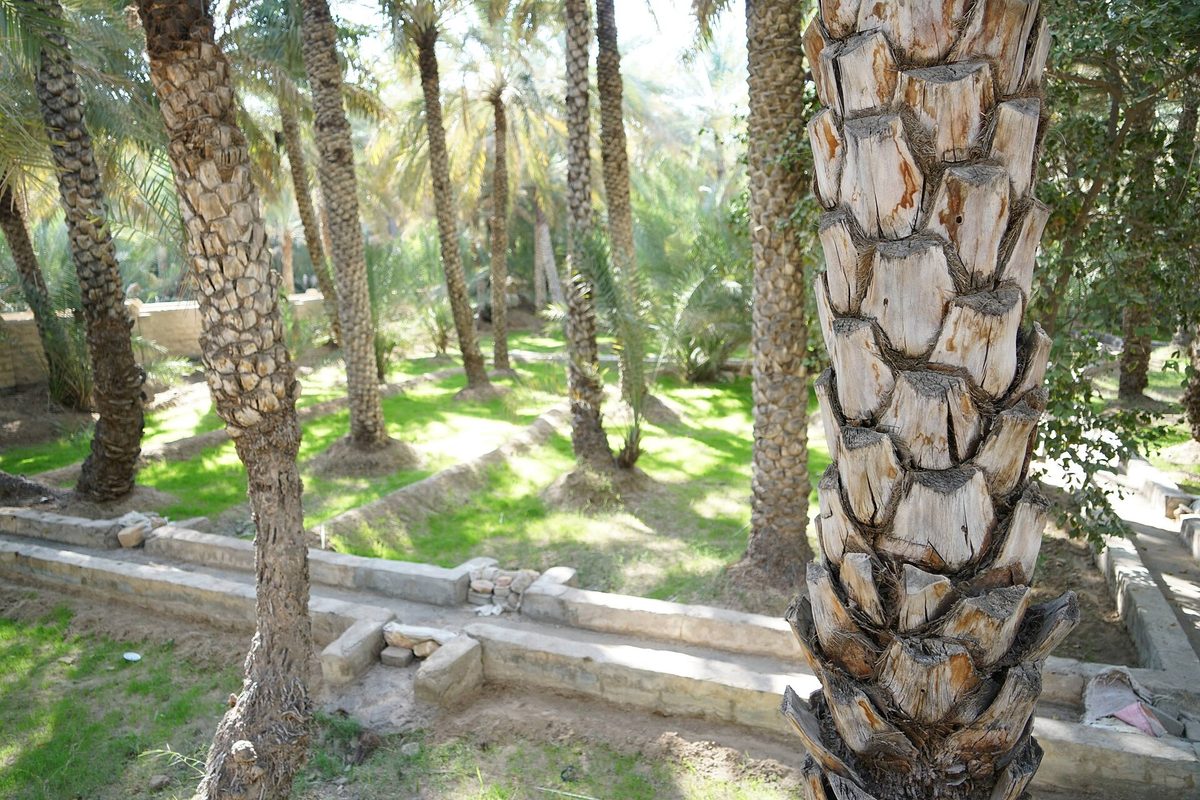
A falaj in the Al Ain oasis: water runs in an open channel between the palms. Photo: Flounder L, CC BY-SA 4.0, Wikimedia Commons.
Al Ain Oasis covers about 1,200 hectares and holds about 147,000 date palms. Its main aflaj are called Al Aini and Dawood. Since 2011 the six oases of Al Ain have been a UNESCO World Heritage Site. According to Abu Dhabi’s Department of Culture and Tourism, the oases themselves go back to the early Bronze Age, around 3000 BC.
Date gardens were the oases’ main livelihood. Many families lived by the seasons: summer on the pearl banks, winter among the palms. If you’d like to walk the shady paths of the oasis, have a look at my Al Ain day trip from Dubai.
Palm-frond houses and wind towers
Most people lived in huts made of palm fronds, called arish or barasti. The walls were built from panels of palm leaves: woven tighter for winter to keep the wind out, and left with gaps in summer to let the breeze through. Like a Bedouin tent, an arish was set facing the prevailing wind.
Wealthy families built sturdier houses: from coral stone set in gypsum mortar on the coast, and from mud brick inland. Thick walls kept out the heat, and above the roofs rose barjeel, wind towers that catch the breeze and send it down into the rooms. Today the barjeel is one of the most recognisable symbols of Emirati architecture.
You see these houses best in Al Fahidi and Al Shindagha. I explain how to read those lanes in my old Dubai walking route.
Trade and the Creek
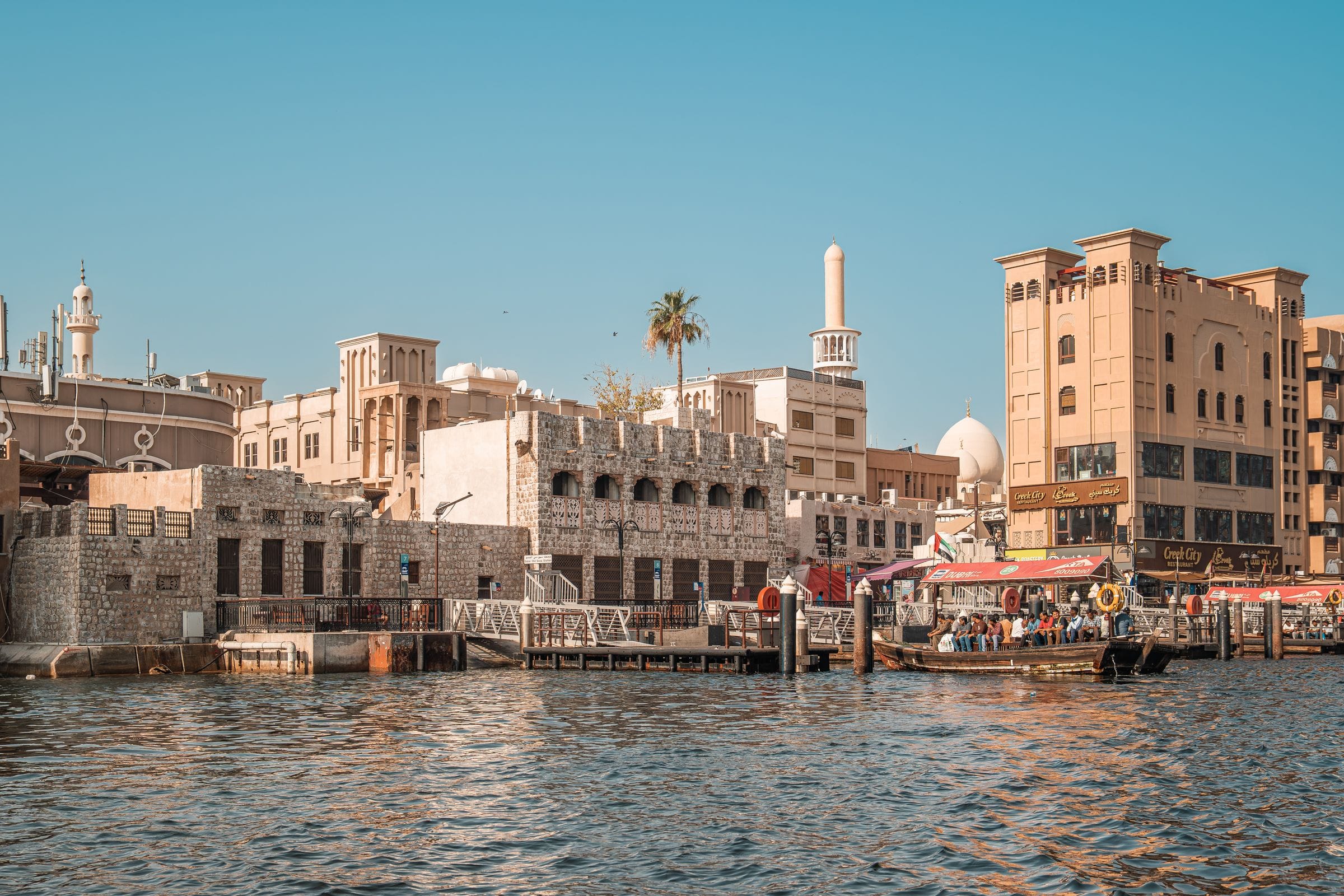
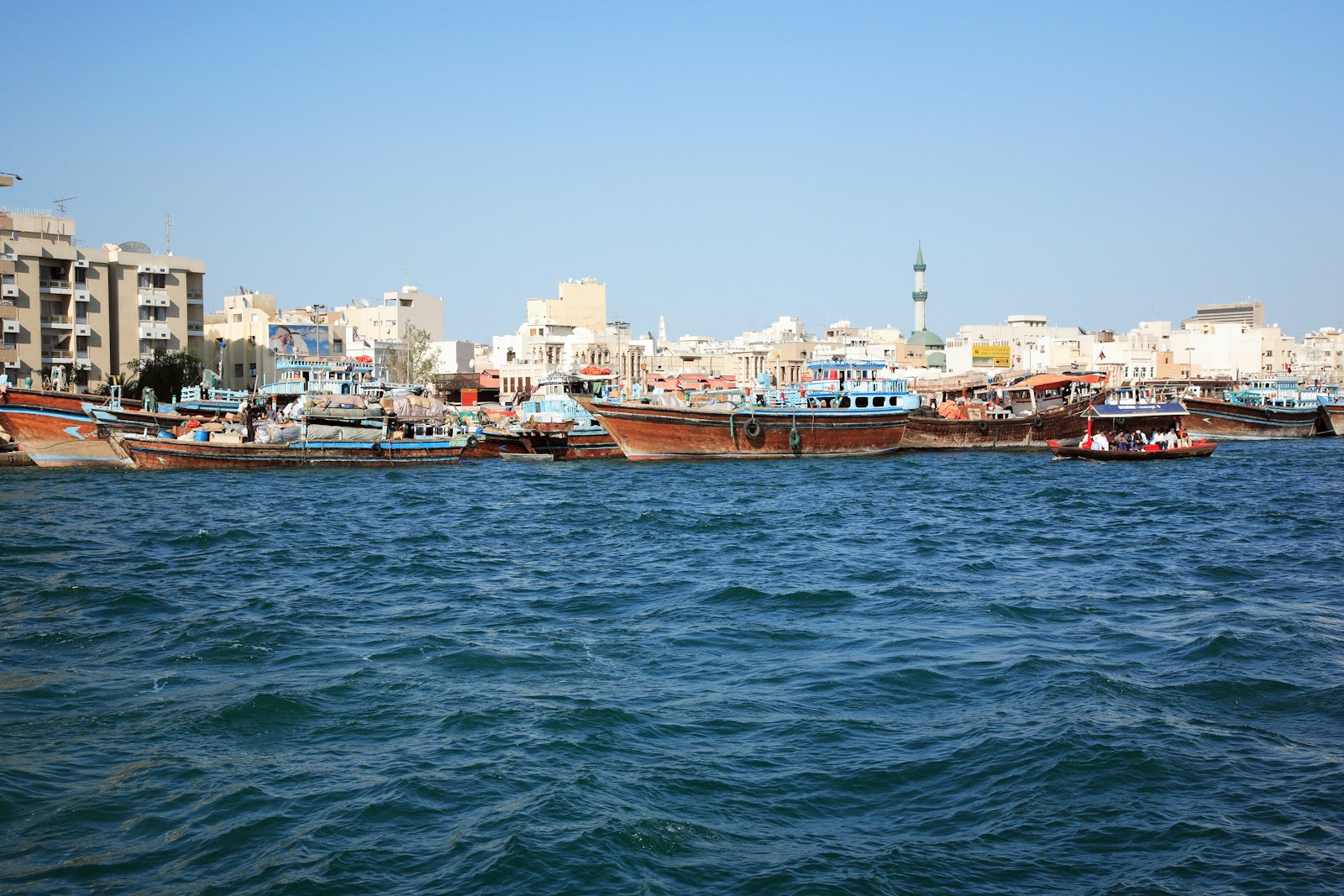
For centuries the coast’s position on the Gulf drew merchants from India and China, and later the Portuguese, Dutch and British. Dubai grew up around the Creek, a natural inlet where boats could moor easily.
Al Shindagha, at the mouth of the Creek, is considered the birthplace of Dubai. It was settled by the Al Bu Falasah tribe of the Bani Yas, and in 1833 the Al Maktoum family made its home here. In 1896 Sheikh Saeed bin Maktoum built a house here that remained the family’s residence until 1958. Today Al Shindagha is a large open-air museum: 22 pavilions in 80 restored houses, including ones on sea culture, pearl diving and navigation.
Oil: the end of an era
Oil company geologists first arrived in the early 1930s, just as the pearl trade was collapsing. The wait was long. In 1958 oil was found offshore near Das Island, and in 1962 the first tanker of oil left Abu Dhabi. Dubai started exporting in 1969.
After that everything changed very fast: schools, hospitals, roads, and then a country. I tell how seven sheikhdoms came together as one nation in how the UAE was formed, and about the man who brought them together in Sheikh Zayed: the man who built a country.
Where to see this history today
- Old Dubai. Al Fahidi with its wind towers, an abra across the Creek, the spice souk. Swap the gold souk for Al Shindagha Museum and you get almost the full story of life before oil. All of this is part of my Old Dubai tour.
- Abu Dhabi. Qasr Al Hosn stands on the site of a 1790 watchtower, the city’s first permanent building. The contrast with the towers around it says it all. It’s easy to add to my Abu Dhabi day tour.
- Al Ain. The oasis with its aflaj and date groves is a living picture of how people survived in the desert.
Museum hours and ticket prices change, so check them before you go.
How I can help
I run private tours of old Dubai and Abu Dhabi with pick-up from your hotel. Along the way I tell the story you won’t find on the signs: how the pearl divers lived, why the houses stand so close together and where Dubai’s trading character comes from. Tell me how many days you have, and I’ll put together a route that makes the history of the Emirates come together as one picture.
Checked on 11 October 2026. Sources: UAE Ministry of Foreign Affairs, Abu Dhabi Department of Culture and Tourism, Visit Abu Dhabi, The National, Gulf News.
Practical answers
Frequently asked questions
How did people in the UAE make a living before oil?
From the sea and the oases: pearl diving, fishing, sea trade and date gardens. Many families lived a semi-nomadic life, going pearling in summer and tending their date palms in winter.
Why did pearl diving end in the UAE?
Because of the global depression of the late 1920s and early 1930s, and Japanese cultured pearls, which were much cheaper than natural ones. Demand collapsed, and very poor years began on the coast.
When was oil discovered in the UAE?
Oil company geologists were already working here in the early 1930s. Oil was found offshore near Das Island in 1958, the first export left Abu Dhabi in 1962 and Dubai followed in 1969.
How long was the pearl diving season?
The main season lasted four months, from 1 June to 30 September, and was called al-ghaus al-kabir, the great dive. Shorter seasons followed in October and November.
What is a falaj?
A system of underground and surface channels that carries water from the mountains down to the oases by gravity. In Al Ain the aflaj have worked for about three thousand years, and the city's oases have been a UNESCO World Heritage Site since 2011.
Where can I see how people lived before oil in Dubai?
In Al Fahidi and Al Shindagha on Dubai Creek. Al Shindagha Museum has 22 pavilions, including ones on pearl diving and navigation. In Abu Dhabi visit Qasr Al Hosn, and in Al Ain the oasis.