Guests often ask me: “Is it true you can’t share a hotel room in Dubai unless you’re married?” or “Can I have a coffee during the day in Ramadan?” Many of the answers you’ll find online are five to ten years out of date. In recent years the Emirates have changed the laws on alcohol, on living together and on foreigners’ family matters, the Ramadan rules for restaurants, and even the days of the week the country takes off.
I’ve lived in the Emirates for more than 15 years, and I’ve put in one place how things were and how they are now. This isn’t about religion “loosening”: Sharia still governs family matters for Muslims, and fasting remains part of the country’s life. What changed were the civil laws and city rules that affect residents and visitors.
November 2020: the big reform
On 7 November 2020 the UAE President, Sheikh Khalifa bin Zayed, approved a package of federal amendments to criminal and civil law. They took effect immediately. The main points:
- Alcohol. Drinking stopped being a crime. The minimum age is 21. You can drink at home or in licensed venues; selling alcohol to minors is still illegal.
- Living together. Unmarried couples, and men and women who aren’t related, no longer break the law by sharing a flat or a hotel room.
- Foreigners’ inheritance and divorce. A foreigner’s estate can be divided under the law of their own country if there’s no will. Property in the UAE remains subject to local law. Dividing assets on divorce for a couple who married abroad follows the law of the country where they married.
- A “good Samaritan” law. Someone who helps a person in trouble in good faith and accidentally causes harm isn’t punished.
Courts also became required to provide an interpreter for anyone who doesn’t speak Arabic.
Family law for non-Muslims: 2021–2023
Abu Dhabi took the next step. In November 2021 the emirate passed a personal status law for non-Muslims: civil marriage, divorce, joint custody, maintenance and inheritance without going to a Sharia court. A separate court working in Arabic and English was set up for these cases.
At the federal level a similar system came in with Federal Decree-Law No. 41 of 2022 on civil personal status. It has applied since 1 February 2023 and covers non-Muslim citizens and residents, who can also choose the law of their own country. If you’re a resident and this affects you, go through the details with a lawyer: there are a lot of nuances.
Alcohol: from personal licence to hotel bar
How it was. Before 2020, alcohol was sold in licensed bars and restaurants, but to buy a bottle in a shop and keep it at home you needed a personal licence. In Dubai you applied with your Emirates ID, a form and a 270 dirham fee. Tourists got a temporary licence with their passport right in the shop.
What changed:
- September 2020, Abu Dhabi. The Department of Culture and Tourism abolished personal licences. Residents and tourists over 21 can buy alcohol for themselves in licensed shops and drink at home or in licensed venues.
- November 2020, the whole country. The federal reform decriminalised drinking.
- January 2023, Dubai. The personal licence became free, and the 30% municipal alcohol tax stopped being charged.
- January 2025, Dubai. The 30% tax came back after a two-year break.
How it works now, emirate by emirate. In Dubai you don’t need anything to drink in a licensed bar or restaurant. A licence is needed to buy alcohol in a shop: residents get it with their Emirates ID, tourists with their passport. Abu Dhabi abolished personal licences back in 2020, and in the other emirates where alcohol is sold, tourists don’t need a licence. The age is 21 everywhere. Sharjah is the exception: there, drinking and even keeping alcohol is banned.
The weekend: from Friday to Saturday and Sunday
Many people still think the Emirates’ weekend is Friday and Saturday. That was the case from 2006 to 2021. The full history:
- 1971–1999: one day off, Friday;
- 1999–2006: Thursday and Friday;
- 2006–2021: Friday and Saturday;
- from 1 January 2022: Saturday and Sunday.
Federal offices now work Monday to Thursday from 7:30 to 15:30 and on Friday from 7:30 to 12:00. The Friday sermon and prayer take place at 13:15 all year round, after the working day ends. Dubai and Abu Dhabi moved to the same pattern.
Sharjah went its own way: its public sector works four days, Monday to Thursday, with Friday, Saturday and Sunday off. Private companies choose their own schedules, so on Fridays banks, offices and clinics may keep different hours.
What it means for your trip. On Saturdays and Sundays the beaches, parks and malls fill up with residents, and there’s more traffic getting there. If you want a quiet beach or a calm mall, plan it for a weekday. Government offices only work until noon on Friday, worth remembering if you need to sort out any paperwork.
Ramadan then and now
This is the most noticeable change for tourists. A full guide to travelling in Ramadan is in my post on Ramadan in Dubai for tourists. Here it’s only how the rules have changed.
How it was. Under the 1987 Penal Code (Article 313), eating, drinking or smoking in public during fasting hours could mean a month in prison or a fine of up to 2,000 dirhams, and that included drivers in cars. Many restaurants only opened after sunset. The Dubai Mall food court was closed during the day in Ramadan 2013. Later, food courts began opening in the daytime, but behind screens and curtains. Restaurants needed a separate permit to serve guests before iftar, and dining rooms were hidden from the street.
What changed:
- Ramadan 2021. Dubai Economy issued a circular: restaurants no longer had to screen off dining areas or get a permit to open during fasting hours. The same year, cafes and restaurants in Abu Dhabi’s malls were also allowed to remove their partitions.
- Ramadan 2022. Dubai’s Department of Economy and Tourism (DET) confirmed that screens are at the restaurant’s discretion and no permit is needed.
- Ramadan 2025. Eating and drinking are allowed in all areas of the malls in Dubai and Abu Dhabi.
For a visitor today, Ramadan also means iftars: the evening meal that breaks the fast, to which guests are traditionally invited. In March 2025 we went to an iftar at a Dubai hotel, and I even tried my hand as an Arabic barista with a heavy dallah coffee pot. And in old Deira, before sunset, you can watch the whole neighbourhood getting ready for iftar.
What stayed. Non-Muslims don’t have to fast. But during fasting hours it’s not the done thing to eat, drink, chew gum or smoke on the street, on public transport or even in a car if you can be seen. The National’s Ramadan 2025 guide reminds readers that formally this can still bring a fine of up to 2,000 dirhams or up to a month in jail, though in practice it’s rarely applied. Children can eat and drink in public.
People also expect you to:
- dress more modestly than usual;
- keep music down, especially during prayer;
- not swear or make a scene;
- remember that the working day is legally two hours shorter, so offices and government departments close earlier.
Sharjah is stricter: according to The National in 2025, restaurants there still need a permit to open during the day.
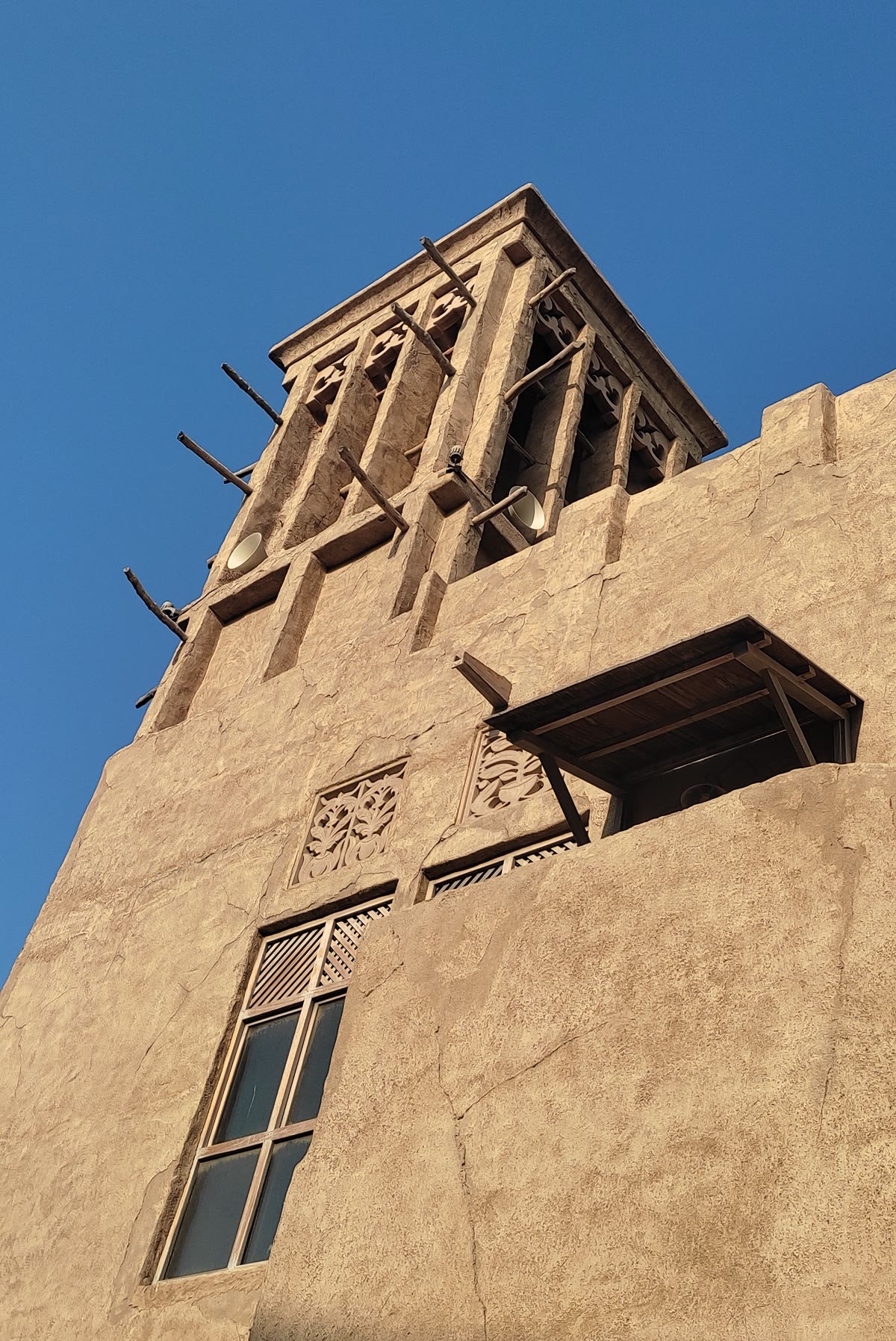
A wind tower on a house in Al Seef: the traditional architecture of old Dubai. Photo: RPSkokie, CC BY-SA 4.0, Wikimedia Commons.
What hasn’t changed
The reforms made life freer, but some rules are still strict, and for visitors these matter most:
- Drugs. Zero tolerance. Even traces in your blood count as possession, and CBD products can be illegal. If you’re bringing medication, check what’s in it before you travel.
- Being drunk in public. You can have a drink in a bar, but you can’t be drunk on the street, in a taxi or at the airport, in any emirate.
- Photographing people. You can’t photograph people or post them online without their consent. Under Article 44 of Federal Decree-Law No. 34 of 2021, invading someone’s privacy can mean at least six months in prison and/or a fine of 150,000 to 500,000 dirhams.
- Rudeness, online and off. Swearing and offensive gestures, including in messages and on social media, are offences.
- Public displays of affection. Living together is allowed, but kissing in the street can still end in detention.
- Clothing. In the city it’s customary to cover shoulders and knees; swimwear is for the beach and the pool. Mosques have their own dress rules, which I cover in detail in my Sheikh Zayed Grand Mosque tips.
- Sharjah. Since 2001 the emirate has had a decency code: women shouldn’t wear clothes that show the stomach or back, are above the knee or are tight, and men shouldn’t wear very short shorts or go shirtless. Before you go, read my post on things to do in Sharjah.
The good news: locals rarely correct tourists rudely. More often someone will simply give you a polite hint. How hospitality and etiquette work here is in my post on UAE traditions, and who actually lives in the country is in who lives in the UAE.
Then and now: a quick table
| Topic | Then | Now |
|---|---|---|
| Alcohol | Personal licence to buy; drinking itself could lead to a charge | From 21 in licensed bars and at home; free licence for shops in Dubai; banned in Sharjah |
| Alcohol tax in Dubai | 30% | Not charged in 2023–2024, 30% again since 2025 |
| Unmarried couples | Living together banned | Allowed since November 2020 |
| Family matters for non-Muslims | Marriage and divorce under general law based on Sharia | Civil law: Abu Dhabi since 2021, the whole country since February 2023 |
| Weekend | Friday and Saturday (2006–2021) | Saturday and Sunday, Friday a short day; three-day weekend in Sharjah |
| Restaurants in Ramadan | Closed in the daytime or behind curtains, permit needed | In Dubai open without screens or a permit since 2021 |
| Eating in public in Ramadan | Fine of up to 2,000 dirhams or a month in jail | A fine is formally possible but rarely applied; courtesy rule: don’t eat in view |
| Drugs, photographing people, public drunkenness | Strict | Just as strict |
How I can help
I run private tours with pick-up from your hotel or the airport, and I always explain the local rules along the way: where you can take photos, how to dress for a mosque, what to keep in mind in Ramadan. If your trip falls during the fast, I’ll plan the day so lunch and iftar are in convenient places and the drives avoid the pre-sunset traffic.
To see what Dubai was like before the skyscrapers, join my walk through Old Dubai. And if you want to see both the old and the new city in a day, my Dubai sightseeing tour is the one.
This isn’t legal advice: rules change, so check the emirate’s current requirements before you travel.
Checked on 11 October 2026. Sources: u.ae, GOV.UK, Khaleej Times, Gulf News, The National, Gulf Business, LexisNexis Middle East.
Practical answers
Frequently asked questions
Can tourists drink alcohol in the UAE?
Yes, if you're 21 or over: in licensed bars and restaurants and in private. The exception is Sharjah, where alcohol is banned. Being drunk in public is illegal in every emirate.
Do I need an alcohol licence in Dubai?
Not to drink in a licensed bar or restaurant. To buy alcohol in a shop in Dubai you get a free licence: residents with their Emirates ID, tourists with their passport right in the shop. Abu Dhabi abolished personal licences in 2020.
Can you eat in public during Ramadan in Dubai?
In restaurants and cafes, yes: since 2021 they serve during the day without screens or a separate permit. On the street, on public transport and in a car where you can be seen, it's better not to eat or drink, out of respect for those fasting.
What is the weekend in the UAE?
Since 1 January 2022 government offices close on Saturday and Sunday and work until noon on Friday. In Sharjah the public sector has a three-day weekend: Friday, Saturday and Sunday. Private companies set their own schedules.
Can unmarried couples live together in the UAE?
Yes. The ban on unmarried couples living together was lifted by the November 2020 amendments. Public decency norms remain: hugging and kissing in public are not the done thing.
What is still strict in the UAE?
Drugs (zero tolerance; even traces in your blood count as possession), being drunk in public, photographing people without consent, rudeness and offensive gestures, including online, and the dress code in mosques and government buildings.