I’ve lived in the Emirates for more than 15 years, and guests often ask me: “So where are the locals?” In one day in Dubai you can be served by people from five different countries, and you might only see an Emirati in national dress from a distance in a mall.
That’s not chance, it’s how the country works. In this article: how many people live in the UAE according to official statistics, what share are Emiratis, which communities are the largest (with an honest note where the figures are estimates), which languages you’ll hear, who does which jobs and what of all this is useful to know as a visitor.
How many people live in the UAE
The latest official figures come from different agencies and for different dates, so you can’t simply add them up:
- The whole country: 11,294,243 people at the end of 2024, according to the federal statistics centre FCSC. 64% men, 36% women.
- Dubai: 4.58 million at the end of 2025, according to the Dubai Data and Statistics Establishment (published in July 2026). At daytime peak hours the city holds an average of 6.39 million people: commuters from the neighbouring emirates, plus tourists and business visitors.
- The emirate of Abu Dhabi: 4,135,985 people in 2024, according to the Statistics Centre Abu Dhabi (June 2025).
- Sharjah: 2,135,888 people in the 2025 census.
There are noticeably more men than women, both nationally and in Abu Dhabi (67%). That’s what a country looks like when many people come to work, often without their families.
Emiratis and expats: who is the majority
UAE nationals are a minority in their own country. Federal statistics don’t publish a breakdown by nationality, but some emirates do:
- Dubai: at the end of 2024, 299,600 nationals and about 3.56 million foreign residents, so Emiratis are about 8%;
- Sharjah: in the 2025 census, nationals were 11% (234,431 people) and foreign residents 89%.
For the country as a whole, the research firm Global Media Insight estimates the Emirati share at about 11.5% (estimate as of May 2026). In 2024 the UAE President, Sheikh Mohamed bin Zayed, said that people of more than 200 nationalities live side by side in the country.
“Expat” is a neutral word here: it means any foreigner who lives and works in the country, from a construction worker to a bank’s chief executive.
Which nationalities live in the UAE: the estimates
There’s no official table by nationality, so everything you see online is an estimate. The order of the largest communities is confirmed by the government portal u.ae: Indians first, then Pakistanis and Bangladeshis.
For rough shares, Global Media Insight’s estimate (May 2026, methodology not published, figures approximate) gives:
- India: about 38%;
- Pakistan: about 17%;
- Bangladesh: about 7%;
- Philippines: about 7%;
- Iran: about 5%;
- Egypt: about 4%;
- Nepal and Sri Lanka: about 3% each;
- China: about 2%.
For the Indian community there is a diplomatic figure: India’s Consul General in Dubai cited 4.36 million people as of December 2024, and the ambassador said more than half of them live in Dubai. Beyond these, the country has large communities from the Arab world, Europe, Africa, Central Asia and North America.
Russian speakers in the UAE
There’s no official count here either. Russia’s Consul General in Dubai, Maxim Vladimirov, spoke at the end of 2025 of about 150,000 Russian citizens living in the country (as reported by the business publication AGBI). The Russian-speaking community is wider: it includes people from Belarus, Kazakhstan, Ukraine, the Baltic states and other former Soviet countries. You hear Russian most often in Dubai Marina and on Palm Jumeirah.
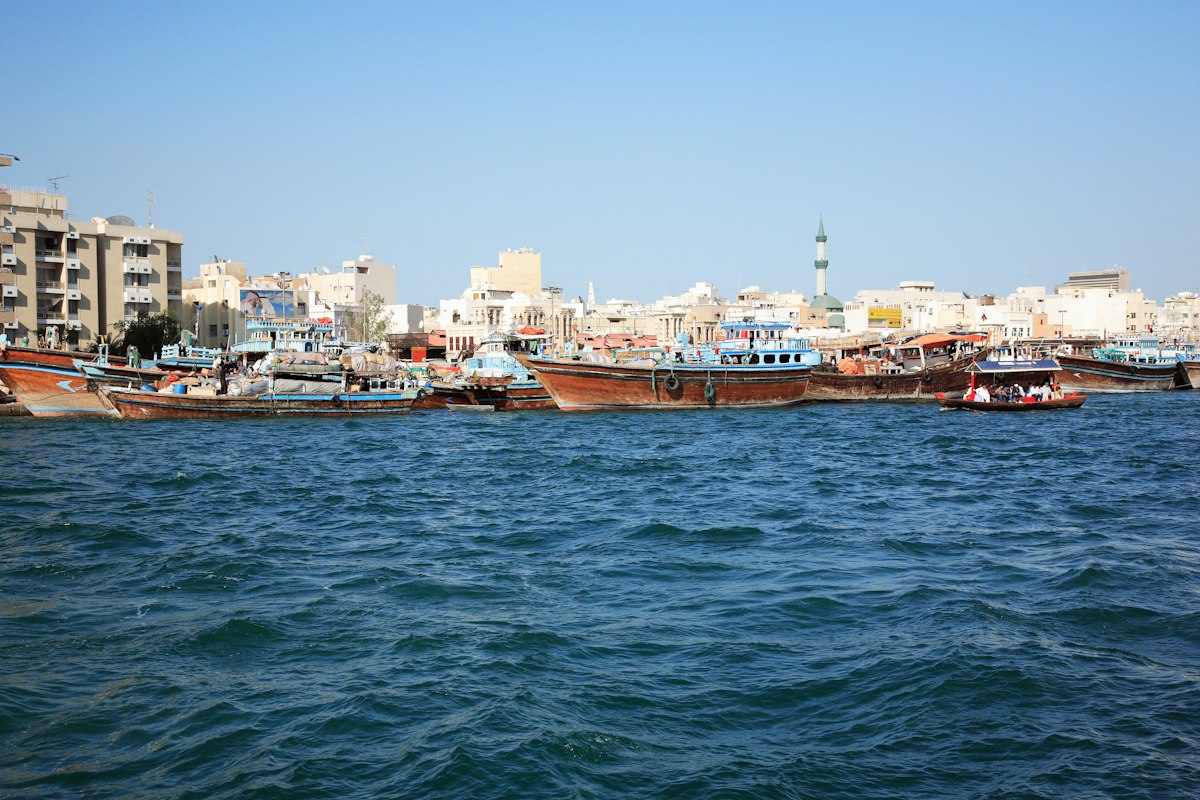
Dubai Creek: dhows load at Deira much as they did decades ago, and the abras carry everyone, office workers, traders and tourists alike. Photo: Saj Shafique, Unsplash.
What language is spoken in Dubai
The official language is Arabic. All road signs, direction signs and shop signs are repeated in English, as the government portal u.ae describes it. The same portal notes that the courts officially use five more languages: English, Chinese, French, Hindi and Russian.
In practice, English is the working language of the city. It’s what you’ll speak in hotels, taxis, shops, restaurants and banks, and it’s how people from different countries talk to each other.
What else you’ll hear:
- Hindi and Urdu: very close in everyday speech, spoken by many people from India and Pakistan;
- Malayalam: the language of the south Indian state of Kerala;
- Bengali: the language of the Bangladeshi community;
- Tagalog: the language of the Filipino community;
- Farsi: the language of the Iranian community;
- Russian: in the areas popular with Russian speakers, and in some hotels and shops.
Emiratis speak a local dialect of Arabic. You don’t need Arabic as a visitor, but “salaam alaikum” and “shukran” (thank you) always get a smile.
Who does which jobs
A useful official framework is the classification used by the Ministry of Human Resources and Emiratisation (MoHRE). Every private-sector job falls into one of nine skill levels: from managers and degree-holding professionals (levels 1–3), through office staff and service and sales workers (4–5), to skilled trades, machine operators and elementary jobs (6–9). A worker counts as skilled at levels 1–5, with an attested qualification above secondary school and a salary of at least 4,000 AED a month.
Abu Dhabi publishes figures on the structure of employment: in 2024, 55.2% of the emirate’s workforce held blue-collar jobs and 44.8% white-collar jobs.
For industries, MoHRE statistics for the end of 2019 (excluding free zones and domestic workers) give a rough picture: about a third of registered private-sector workers in the country were in construction, about a fifth in trade and repairs, and about 5% in hotels and restaurants. The data isn’t new, but it shows the shape of things: the country builds, trades and hosts.
A separate large group is domestic workers: nannies, drivers, cooks, gardeners, home nurses and private tutors. Since 2022 their work has been governed by its own law, which lists 19 occupations.
All these people, from engineers to couriers, keep the city running around the clock. Behind every tower you photograph are thousands of work shifts.
What rights the law protects
Labour law has changed a lot in recent years:
- The Labour Law (Federal Decree-Law No. 33 of 2021, in force since 2 February 2022) replaced the 1980 law: fixed-term contracts of up to three years, at least one paid day off a week, and a ban on forced labour and threats at work.
- The Wage Protection System (WPS): private-sector companies pay salaries through a system the ministry can see. Since 1 June 2026, under the new Resolution No. 340, a month’s salary must arrive no later than the first day of the following month.
- The midday break: from 15 June to 15 September, work under direct sun is banned from 12:30 to 15:00. In 2026 the rule ran for the 22nd year in a row. The fine for an employer is 5,000 AED per worker, up to 50,000 AED.
- The Domestic Workers Law (No. 9 of 2022, in force since 15 December 2022): the worker keeps their own passport, agencies may not charge them recruitment fees, and they are entitled to a paid day off a week, 30 days of leave a year and at least 12 hours of rest a day.
Emiratisation: nationals in the private sector
The state is steadily bringing its citizens into private companies. Companies with 50 or more employees must raise the share of Emiratis in skilled roles by 2% every year, 1% in each half of the year. Since July 2026 the penalty for missing the target is a contribution of 10,000 AED a month for each national not hired. According to MoHRE, in July 2026 more than 190,000 Emiratis worked in the private sector across almost 32,000 companies, and 95% of companies met the first-half target.
This is part of the country’s long-term strategy, which I cover in more detail in my article on UAE Vision 2031 and 2071.
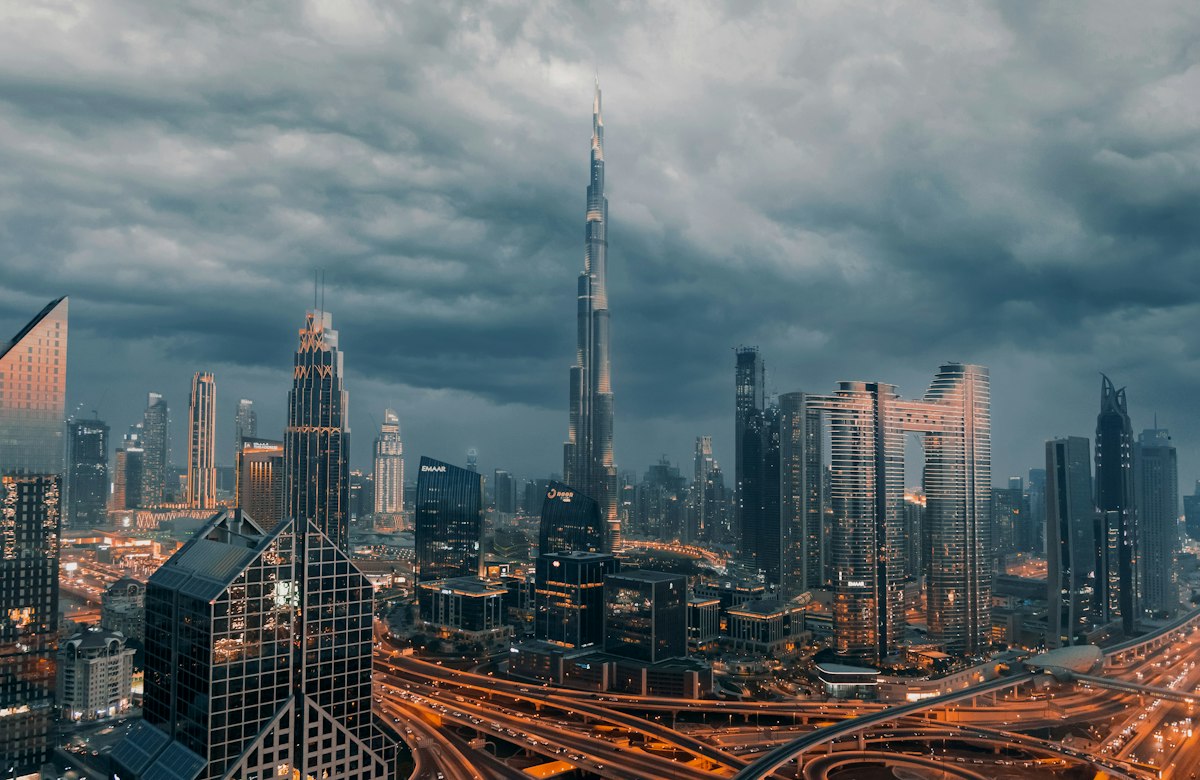
Downtown and Sheikh Zayed Road: every morning hundreds of thousands of people drive in to work here, many of them from the neighbouring emirates. Photo: Ahmed Aldaie, Unsplash.
What this means for a visitor
Even in neighbourhoods where almost everyone is an expat, UAE flags hang from the balconies. In spring 2026 I filmed this in my own area for my stories: no locals live there, and yet there are flags everywhere. For many newcomers, the Emirates really have become home.
- Speak English, even simple English. Hotel staff, taxi drivers and shop assistants are used to every accent.
- Who you’ll meet. At the reception desk, in taxis, cafes and shops you’ll meet people from dozens of countries. Emiratis are about a tenth of the population, so you’ll rarely meet them in service jobs.
- Courtesy. Treat everyone with the same respect and don’t raise your voice. More on local etiquette in my article on UAE traditions.
- Don’t photograph people without permission. Under the cybercrime law (Decree-Law No. 34 of 2021), photographing a person without consent in a way that violates their privacy can bring a fine of 150,000 to 500,000 AED and/or a prison term of at least six months. Don’t take close-ups of construction workers, women in abayas or other people’s children.
- Tipping. It isn’t required, but it’s usual to say thank you for good service. Visit Dubai suggests 10–15% in restaurants, 5–10 AED for a taxi driver, courier or porter, and 10 AED a day for housekeeping. Check the bill: a restaurant service charge often goes to the venue, not the waiter. Keep some 5 and 10 AED notes on you.
Why Dubai became so international, and how the city grew out of a trading port, is the subject of my article on why Dubai succeeded. And for how the other six emirates live, see my overview of the seven emirates of the UAE.
How I can help
You see multinational Dubai best not from a hotel window but in the old town. On my Old Dubai walking tour we cross the Creek by abra, walk through the spice and textile souks of Deira and Bur Dubai, and I tell you who came here to trade and when. If you’d like to see the old and the new city in one day, my Dubai city tour is the better fit. I’ll pick you up from your hotel and answer all your questions about life in the Emirates.
Checked on 11 October 2026. Sources: FCSC, Dubai Data and Statistics Establishment, Statistics Centre Abu Dhabi, Sharjah 2025 census, MoHRE, u.ae, Visit Dubai, Gulf News, Khaleej Times, The National, AGBI; nationality shares are a Global Media Insight estimate (May 2026).
Practical answers
Frequently asked questions
What is the population of the UAE?
11.29 million at the end of 2024, according to the federal statistics centre FCSC. About 4.58 million of them live in Dubai (end of 2025) and about 4.14 million in the emirate of Abu Dhabi (2024).
What percentage of the UAE population are Emiratis?
Roughly one resident in nine or ten. There is no federal breakdown by nationality, but nationals are about 8% of Dubai (2024) and 11% of Sharjah (2025 census), and Global Media Insight estimates about 11.5% for the whole country (2026).
What is the largest nationality in Dubai?
Indians. The Consulate General of India put the Indian community at 4.36 million people in December 2024, more than half of them in Dubai. Estimates then place Pakistanis, Bangladeshis and Filipinos next.
What language do they speak in Dubai?
Arabic is the official language, but English is the working language of the city: you'll use it in hotels, shops, taxis and restaurants. Signs and road signs are bilingual.
How many Russians live in the UAE?
Russia's Consul General in Dubai spoke of about 150,000 Russian citizens at the end of 2025. The Russian-speaking community is larger, with people from Belarus, Kazakhstan, Ukraine and other countries. There is no official count.
Do you need to tip in Dubai?
It isn't required, but it's usual for good service. Visit Dubai suggests 10–15% in restaurants, 5–10 AED for a taxi driver and 10 AED a day for hotel housekeeping.