Guests often ask me on the drive from the airport: “Is Qatar part of the Emirates too?”, “Can I do a day trip to Oman from here?”, “Why is Friday the weekend in Doha but not here?” I’ve lived in the UAE for more than 15 years and I understand the confusion. From a plane the Gulf looks like one country: the same deserts, the same white kandura, the same coffee with dates. But the six neighbours have different currencies, weekends, and rules on alcohol and visas.
This post covers what the UAE shares with Saudi Arabia, Qatar, Bahrain, Kuwait and Oman, how they differ for a traveller, and how to combine the Emirates with a trip next door.
What is the GCC?
The full name is the Cooperation Council for the Arab States of the Gulf, usually called the Gulf Cooperation Council, or GCC. It has six members: the UAE, Saudi Arabia, Qatar, Bahrain, Kuwait and Oman.
According to the Council’s General Secretariat, the foreign ministers of the six countries agreed to set it up on 4 February 1981 in Riyadh. The first summit took place on 25 May 1981 in Abu Dhabi. Summits have been held every year since, and the General Secretariat works from Riyadh.
In 1971 Qatar and Bahrain could have joined the Emirates in one federation, but they chose their own independence. I tell that story in how the UAE was formed. Ten years later all six neighbours sat down at one table as partners.
What the six countries share
- Language and faith. Arabic is the official language everywhere, and Islam the religion. Life runs on two calendars: the usual one and the lunar Hijri calendar. The lunar year is shorter than the solar one, so Ramadan and the Eid holidays arrive about 11 days earlier each year.
- The majlis. A guest room or tent where men gather to discuss the news, receive guests and settle disputes. In 2015 the UAE, Saudi Arabia, Oman and Qatar jointly inscribed the majlis on UNESCO’s intangible heritage list.
- Arabic coffee and dates. Guests are welcomed with a small cup of cardamom coffee from a dallah, the long-spouted coffee pot. The coffee ritual is also on the UNESCO list, nominated by the UAE, Saudi Arabia, Oman and Qatar, with Jordan joining in 2024. And UNESCO recognised the traditions of the date palm in 2022, nominated by 15 countries including all six Gulf states.
- Clothes. Men wear a long white robe, called a kandura in the UAE and a thobe or dishdasha next door. Women wear a black abaya. The cut, the collar and the headdress differ by country, and locals can tell their neighbours apart at a glance.
- A maritime past. Before oil, the coast lived on pearls, fish and trade by wooden dhow. How that looked in the Emirates is in my post on the UAE before oil.
- Money. Five of the six currencies are pegged to the US dollar. Kuwait is the exception: since 2007 its dinar has been pegged to a basket of currencies.
- Ramadan for visitors. In Saudi Arabia, Qatar, Bahrain, Kuwait and Oman, the UK Foreign Office advises tourists not to eat, drink or chew gum in public during daylight hours, including in a car. The UAE is more relaxed for restaurants; details are in my post on Ramadan in Dubai.
I felt the difference myself. In March 2026 some friends and I drove almost 300 km to Oman, right in the middle of Ramadan. In Oman it’s a real Ramadan: in the daytime everything is closed until sunset. The UAE hasn’t been like that for years.

Coffee from a dallah and dates: how guests are welcomed in all six countries. Photo: Slywire, CC BY-SA 4.0, Wikimedia Commons.
How they differ: the key numbers
Capitals, money and the calendar. I worked out the dirham rates from each currency’s official peg to the dollar.
| Country | Capital | Currency | Population, 2024 | Time | Weekend |
|---|---|---|---|---|---|
| UAE | Abu Dhabi | dirham: 3.6725 AED to $1 | 11.0 million | UTC+4 | Saturday and Sunday |
| Saudi Arabia | Riyadh | riyal: 3.75 to $1, about 0.98 AED | 35.3 million | UTC+3 | Friday and Saturday |
| Qatar | Doha | riyal: 3.64 to $1, about 1.01 AED | 2.9 million | UTC+3 | Friday and Saturday |
| Bahrain | Manama | dinar: 0.376 to $1, about 9.8 AED | 1.6 million | UTC+3 | Friday and Saturday |
| Kuwait | Kuwait City | dinar, pegged to a currency basket | 4.9 million | UTC+3 | Friday and Saturday |
| Oman | Muscat | rial: about 0.3845 to $1, about 9.55 AED | 5.3 million | UTC+4 | Friday and Saturday |
Population figures are World Bank data for 2024. Watch the time zones: Saudi Arabia, Qatar, Bahrain and Kuwait are an hour behind Dubai. With a connection or a meeting, that’s easy to miss.
The UAE changed its weekend on 1 January 2022 and is now the only Gulf country that rests on Saturday and Sunday. How the weekend and other rules have changed in the Emirates is in my post on UAE rules then and now.
For travellers: alcohol, entry, flights
Entry rules depend on your passport and change often, so I don’t list them country by country. Check each country’s official immigration site and your own government’s travel advice before you book. The rest, as of October 2026:
| Country | Alcohol for tourists | Flight from Dubai |
|---|---|---|
| UAE | in licensed bars and restaurants from 21; banned in Sharjah | n/a |
| Saudi Arabia | banned | Riyadh: about 1 h 55 min |
| Qatar | only in licensed hotels, restaurants and bars, from 21 | about 1 h 10 min |
| Bahrain | allowed; being drunk in public is not | about 1 h 15 min |
| Kuwait | banned | about 1 h 45 min |
| Oman | in licensed hotels, restaurants and clubs, from 21 | Muscat: about 1 h 10 min |
The alcohol rules follow the UK Foreign Office travel advice (GOV.UK). In Saudi Arabia and Kuwait, alcohol can bring serious penalties up to prison, and you can’t bring it in, so don’t pack even a duty-free bottle. Being drunk in public is illegal in the UAE and its neighbours alike.
Flight times are approximate; check your own booking. Before travelling to any Gulf country, read your government’s current travel advice and the terms of your insurance.
The GCC Grand Tours visa: what we know
The idea is simple: one visa for all six countries, like Schengen in Europe. The Gulf interior ministers approved it in November 2023 at a meeting in Muscat. A launch was expected at the end of 2025, then Saudi Arabia’s tourism minister, Ahmed Al Khateeb, gave a new target: 2026.
As of October 2026 the visa still doesn’t exist. On 6 September 2026 GCC Secretary General Jasem Al Budaiwi said in Riyadh that it would come “soon”. He gave no launch date, price, validity or application process. So the figures circulating on travel sites aren’t confirmed by anything yet.
Separately, since February 2026 there’s been a pilot between Abu Dhabi and Bahrain airports: passengers complete passport formalities on departure and don’t stop at immigration on arrival. It’s not a visa, just a faster flight between two countries.
How to combine the UAE with its neighbours
Oman by car
The Emirates have several land crossings with Oman. Gulf News lists five: Al Darah near Ras Al Khaimah (the road to Musandam and Khasab), Dibba near Fujairah, Hatta, Khatmat Malaha (the road to Sohar and Muscat) and Mezyad near Al Ain. What to know:
- Exit fee. Leaving the UAE by land costs 35 AED at the border.
- Documents. According to Gulf News, your passport should be valid for at least six months. Check whether your nationality needs an Oman visa for a short trip. At the border you may be asked for a return ticket, a hotel booking and medical insurance.
- The car. You need insurance valid in Oman. If you don’t have it, an “orange card” is sold at the border: about 106 AED, for at least five days, and it only covers damage to others. If you’re driving a rental, ask the company in advance whether it allows the car into Oman and whether its insurance applies there. Gulf News recommends renting from international companies.
Musandam: Oman in a day
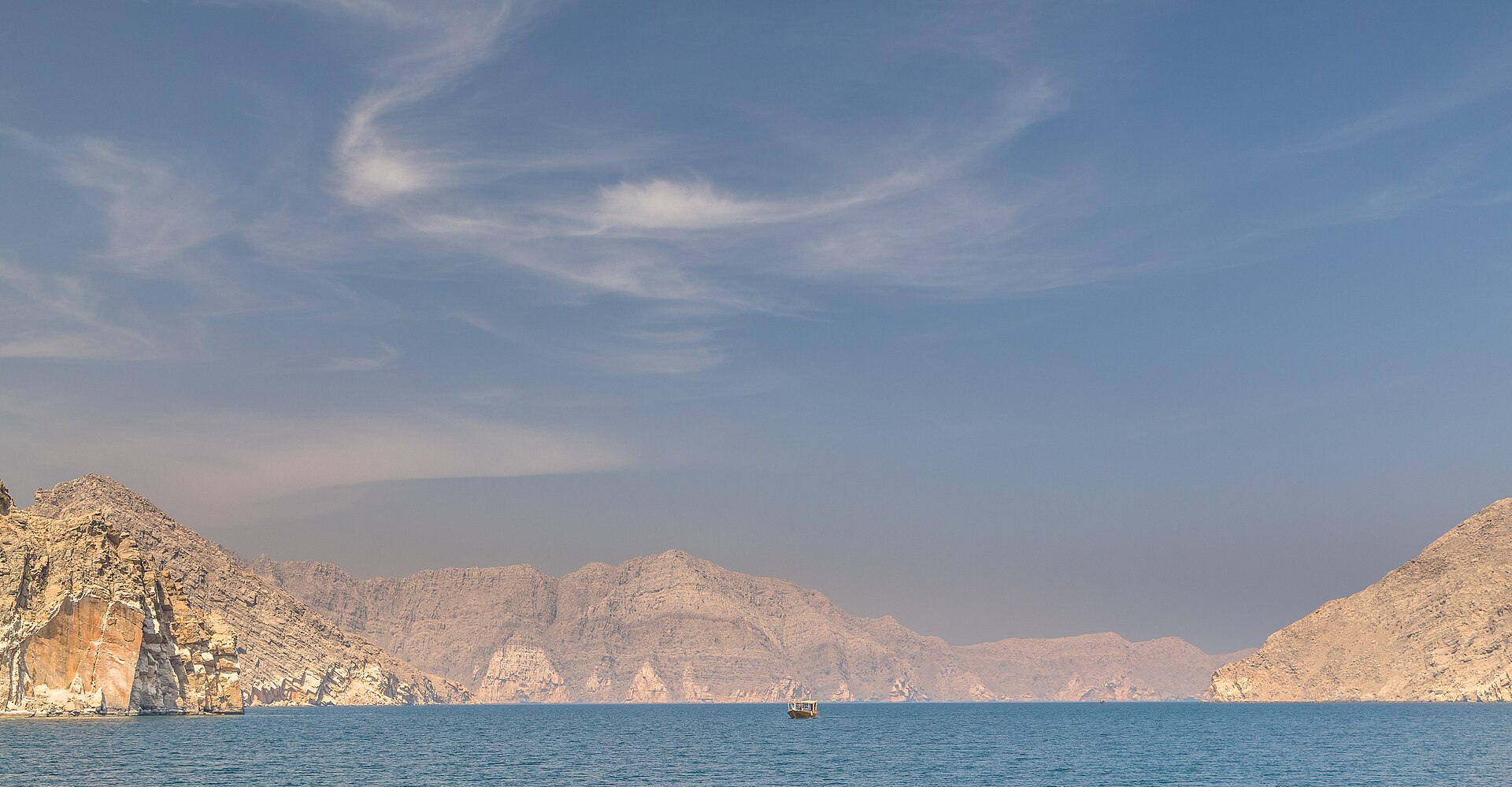
The closest part of Oman to Dubai is the Musandam peninsula with its fjords. It’s cut off from the rest of Oman by UAE territory, and the road to Khasab goes through the Al Darah crossing near Ras Al Khaimah. The easiest way to go is a Musandam cruise from Khasab port: fjords, snorkelling and lunch on board. What else to see on the way is in my post on things to do in Ras Al Khaimah.
Muscat, Doha, Manama by air
Flights from Dubai to the neighbouring capitals take from just over an hour to two hours, so they’re easy to add to a trip for two or three days. Remember that the neighbours’ weekend is Friday and Saturday, and life has a different rhythm on those days.
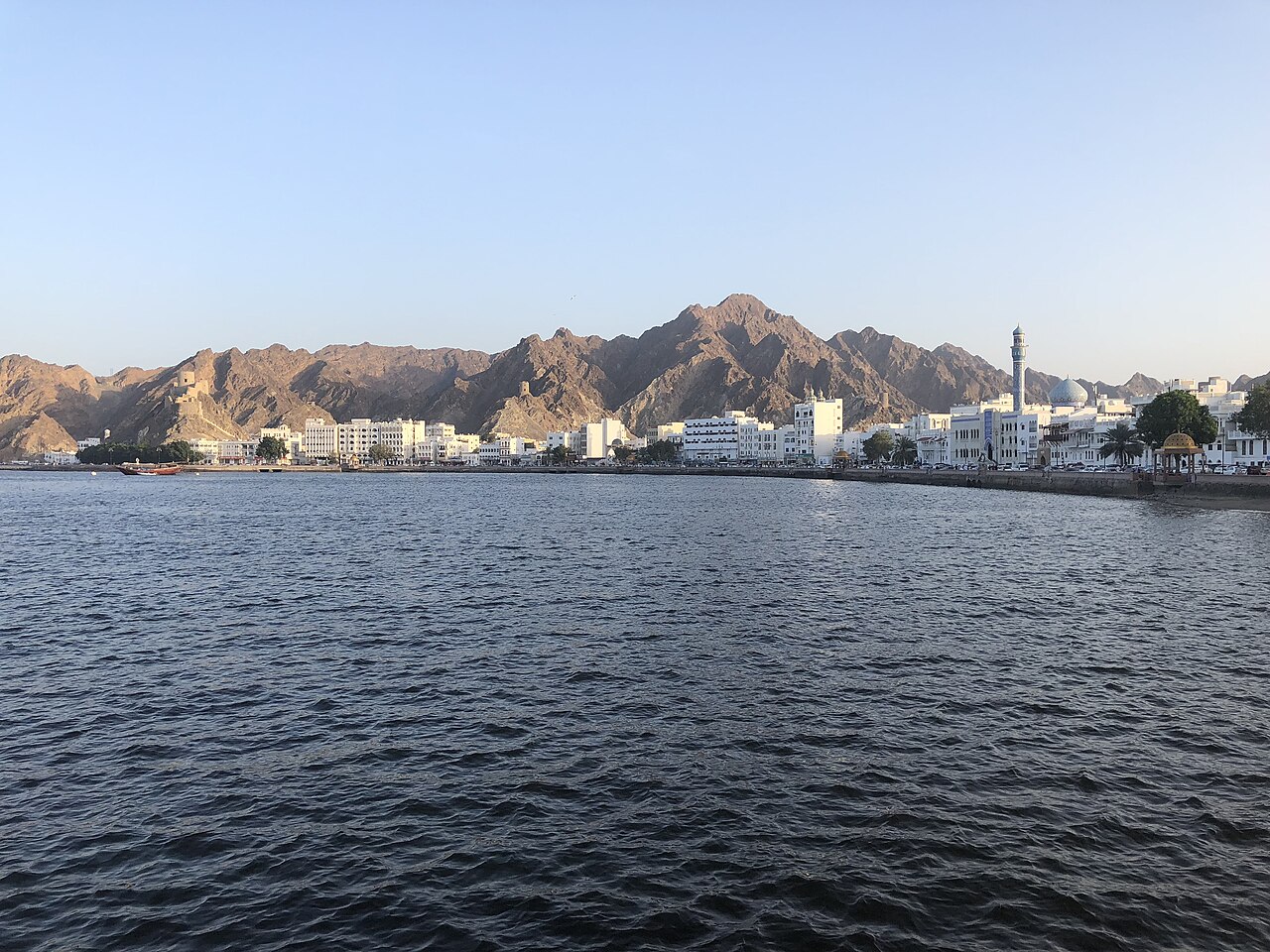
Muttrah Corniche in Muscat: just over an hour’s flight from Dubai. Photo: Albinfo, CC BY 4.0, Wikimedia Commons.
Why travellers usually choose the UAE as a base
That doesn’t make the neighbours worse: every Gulf country has its own character, and each is worth a visit. But for a first trip, starting with the Emirates is more practical, and here’s why:
- Flights. Dubai airport handled 95.2 million passengers in 2025, with flights to 291 cities in 110 countries. How the UAE compares with Turkey on flights and prices is in my post UAE or Turkey.
- Choice. Hotels, beaches, desert, mountains and big cities within a couple of hours’ drive. How the emirates differ is in my guide to the seven emirates, and I compare Dubai and Abu Dhabi separately.
- No car needed. Buses run between the emirates, and now a train too. How it all works is in my post on public transport in the UAE.
- Easy to get by. English is the everyday language of hotels, clinics and services, so you won’t be explaining yourself with gestures.
- Neighbours close by. Muscat, Doha or Manama are about an hour’s flight from Dubai.
How I can help
I run private tours across the UAE with pick-up from your hotel: Dubai sightseeing, Abu Dhabi in a day and the other emirates. On the way I explain how the Emirates resemble their neighbours and how they differ.
Of the neighbouring countries, I only book Musandam: the fjord cruise from Khasab. I don’t run tours in Saudi Arabia, Qatar, Bahrain, Kuwait or the rest of Oman. But if you’re flying on to the neighbours from Dubai, I’ll arrange your airport transfer and help you plan the days in the Emirates before and after. Send me your dates and I’ll suggest how to fit it all in.
This isn’t legal advice: visa rules and fees change, so check them before you travel.
Checked on 11 October 2026. Sources: GCC General Secretariat, World Bank, UNESCO, GOV.UK, Central Bank of Kuwait, Khaleej Times, Gulf News, Arab News, Interfax, Dubai Media Office.
Practical answers
Frequently asked questions
Which countries are in the GCC?
Six: the UAE, Saudi Arabia, Qatar, Bahrain, Kuwait and Oman. The Gulf Cooperation Council was founded in 1981, its first summit was held in Abu Dhabi on 25 May 1981, and its General Secretariat is in Riyadh.
Is there a single tourist visa for the Gulf countries?
Not as of October 2026. The visa, known as GCC Grand Tours, was approved by the Gulf interior ministers in November 2023. On 6 September 2026 the GCC Secretary General said it would come "soon" but gave no launch date. For now, each country has its own entry rules.
Do I need a visa for Oman, Qatar or Saudi Arabia?
It depends on your passport. Many nationalities can get a visa on arrival, an eVisa or visa-free entry, and the list keeps growing. Check each country's official immigration site and your own government's travel advice before you book.
Can you drive from Dubai to Oman?
Yes. There are several border crossings, including Hatta, Dibba and Al Darah near Ras Al Khaimah, which leads to Musandam. Leaving the UAE by land costs a 35 AED exit fee, and the car needs insurance valid in Oman. Check whether your passport needs an Oman visa.
In which Gulf countries can tourists drink alcohol?
In the UAE, Qatar, Bahrain and Oman, in licensed venues; in the UAE, Qatar and Oman from age 21. Alcohol is banned in the emirate of Sharjah, in Saudi Arabia and in Kuwait. Being drunk in public is illegal in the UAE and its neighbours alike.
Why does the UAE have a Saturday–Sunday weekend when its neighbours don't?
The UAE switched to Saturday and Sunday on 1 January 2022, and Friday became a short working day. Saudi Arabia, Qatar, Kuwait, Bahrain and Oman take Friday and Saturday off.


